Why Automotive Lines Choose Hex Washer Head Self Tapping And Self Drilling Screw

Why Automotive Lines Use Hex Washer Head Self-Tapping and Self-Drilling Screws

Welcome to the trenches of automotive procurement. If you are sourcing for a Tier 1 or Tier 2 manufacturer, you know that every fraction of a cent and every second on the factory floor counts. That is exactly why the Hex Washer Head Self Tapping And Self Drilling Screw has become an absolute workhorse in modern vehicle assembly. It is not just about holding two pieces of metal together; it is about doing it faster, cheaper, and with fewer moving parts.
I have walked countless factory floors, and the consensus among production managers is clear: consolidating parts and eliminating steps is the name of the game. These fasteners do exactly that by combining the drill, the tap, and the washer into a single piece of hardware. When you are sourcing Automotive Fasteners, understanding the mechanical advantages behind this efficiency is crucial for protecting your bottom line.
Assembly speed and labor savings
Time is quite literally money on an assembly line. By using a fastener that drills its own hole and forms its own mating threads, you completely eliminate the need for a separate pre-drilling or punching operation. I have seen assembly cycle times drop by up to 30% simply because operators no longer have to align pre-punched holes or swap out drill bits. The built-in washer head also means workers aren’t fumbling with loose washers, which reduces repetitive motion injuries and speeds up the fastening process.
Common automotive applications
You will find these screws everywhere in modern vehicle architectures. They are heavily utilized for attaching interior dashboard brackets, securing wire harness clips to the chassis, and mounting HVAC components. Because they excel at joining sheet metal to thicker structural frames, they are a staple on the Assembly Line for non-structural body panels and heat shields where high-torque fastening is required without the hassle of a nut-and-bolt assembly.
Buyer priorities: cost, quality, supply reliability
As a buyer, your job is a constant balancing act. You need to drive down the Bill of Materials (BOM) cost without compromising on the zero-defect goals of the automotive industry. A cheap screw that snaps under torque or rusts after a year is far more expensive than a premium fastener, once you factor in line stoppages or warranty claims. Therefore, buyers prioritize suppliers who offer consistent metallurgical quality and rock-solid supply chain reliability over those who just offer the lowest piece price.
What Buyers Should Specify When Sourcing
You cannot just send an RFQ asking for “a million hex screws” and expect good results. I always tell procurement teams that ambiguity is the enemy of quality. When you are buying at scale, your technical drawings and specification sheets need to be absolutely bulletproof to prevent costly misunderstandings.
The Hex Washer Head Self Tapping And Self Drilling Screw relies on incredibly tight tolerances to function correctly. If the drill point is too dull, the threads are out of spec, or the heat treatment is uneven, you are looking at stripped holes, broken drivers, and furious production engineers. Let’s break down exactly what you need to nail down on your RFQs.
Core dimensions and drive features
You need to clearly specify the thread pitch, the screw length, and the exact drill point size (e.g., #2, #3, or #4 point) based on the thickness of the metal you are penetrating. Additionally, the Hex Washer drive size must be standardized to match your factory’s existing pneumatic or electric tooling. Specifying the exact flange diameter is also critical, as this determines the load distribution over the substrate.
| Drill Point Size | Typical Metal Thickness Range | Common Automotive Application |
|---|---|---|
| #2 Point | 0.035″ – 0.090″ | Thin sheet metal, heat shields |
| #3 Point | 0.090″ – 0.175″ | Brackets, structural framing |
| #4 Point | 0.175″ – 0.250″ | Heavy chassis components |
Material and finish options
Carbon steel is the standard for high-hardness drilling, but it requires robust corrosion protection. You must specify the plating. While standard zinc plating (with clear or yellow chromate) is common, many automotive applications now demand advanced zinc-flake coatings like Magni or Geomet. These provide superior salt-spray resistance (often 720+ hours) without the risk of hydrogen embrittlement. For highly corrosive environments, 410 stainless steel might be specified, though it sacrifices some drilling speed.
Required performance data
Do not just ask for dimensions; ask for performance guarantees. Your RFQ should require data on drill speed (how many seconds it takes to penetrate a specific steel thickness at a specific RPM), torque-out limits (the maximum torque before the screw strips the metal), and pull-out strength. Demanding this data upfront weeds out low-tier suppliers who lack in-house testing capabilities.
How These Screws Compare With Alternative Fasteners
Whenever I review a Bill of Materials, I actively look for opportunities to upgrade the fastening strategy. It is easy for engineering teams to stick with legacy machine screws or standard rivets out of habit, but those older methods often require pre-punched holes, precise alignment, and sometimes even a nut on the back end, which slows down production.
Switching to a Hex Washer Head Self Tapping And Self Drilling Screw can radically simplify the manufacturing process. However, it is not a magic bullet for every single joint. You need to know exactly where these fasteners outshine the alternatives and where they hit their limits so you can make informed sourcing decisions.
Self-tapping vs. self-drilling vs. machine screws
It is vital to know the difference. A standard Self-Tapping screw requires a pre-drilled hole; it only cuts its own threads. A self-drilling screw has a distinct flute at the tip that acts as a drill bit, cutting the hole and the threads in one motion. Machine screws, on the other hand, require a pre-tapped hole or a mating nut. For blind joints in sheet metal where you only have access to one side, self-drilling is usually the undisputed winner.
Speed, tooling, and installed cost
Procurement isn’t just about the piece price; it’s about Total Installed Cost (TIC). A machine screw might cost $0.01 less per unit, but if it requires a $50,000 hole-punching die and an extra worker to hold a nut on the back, the TIC is massive. Self-drilling screws require only a standard driver, drastically reducing tooling investments and assembly time, which heavily tilts the TIC in their favor.
When hex washer head designs perform best
The hex washer design shines in high-torque applications. Unlike Phillips or Torx drives, which can cam-out (slip) under heavy pressure, a hex head allows the driver socket to apply massive rotational force safely. The integrated washer flange then distributes that high clamping load over a wider area, preventing the screw head from crushing thin plastics or tearing through sheet metal.
How to Evaluate Suppliers for Automotive Programs
Finding a supplier who can make a screw is easy. Finding a supplier who can deliver five million screws with zero defects, on time, with full automotive documentation? That is the real challenge. Supplier evaluation in this sector requires a magnifying glass and a highly critical eye.
I always look well beyond the initial quote. You need to audit their raw material sourcing, their cold heading machinery, and their quality control gates. A supplier claiming to produce High Precision hardware needs to back it up with hard data, process controls, and international certifications, not just glossy brochures.
Manufacturing and process capabilities
You need to verify their cold heading and thread rolling equipment. Are they using modern, multi-station headers? Even more critical is their heat treatment process. Self-drilling screws must have a hard tip to drill through metal, but a ductile core so the head doesn’t snap off under vibration. If a supplier outsources their heat treatment to a cheap, unverified third party, walk away.
Sampling, MOQ, and tooling terms
Before awarding a contract, evaluate their sampling process. Can they provide a pilot run of 10,000 pieces for line trials? Understand their Minimum Order Quantities (MOQs)—automotive runs typically require MOQs of 100,000 to 500,000 pieces per size to be economical. Also, clarify who owns the custom tooling or dies if you require a proprietary head marking or a non-standard flange diameter.
Quality assurance and nonconformance control
In automotive, the acceptable defect rate is practically zero. Ask if they use automated optical sorting machines (vision systems) to inspect every single screw for thread damage, mixed parts, or malformed heads before packaging. You also need to review their corrective action process (like the 8D methodology) to see how they handle nonconformances if a bad batch does slip through.
What Compliance and Documentation Matter Most
If you are new to automotive procurement, the sheer volume of paperwork might shock you. But veterans know that in this industry, if it isn’t documented, it didn’t happen. Compliance is not just an administrative hurdle; it is your shield against liability, line shutdowns, and catastrophic recalls.
When you are importing a Hex Washer Head Self Tapping And Self Drilling Screw, the physical product is only half the deliverable. The other half is the data package that proves the fastener meets strict global safety, environmental, and engineering standards. Missing documentation can hold up your cargo at customs or get your parts rejected by OEM quality inspectors.
Standards, certificates, and traceability
Your supplier must be ISO 9001 certified at a bare minimum, but for Tier 1 automotive work, IATF 16949 certification is almost always mandatory. You also need strict lot traceability. If a screw fails in the field three years from now, you must be able to trace that specific batch back to the exact coil of steel it was stamped from and the date it was heat-treated.
RoHS, REACH, IMDS, and restricted substances
Environmental compliance is non-negotiable. Fastener coatings must comply with RoHS and REACH, meaning strict bans on heavy metals like hexavalent chromium. Furthermore, every material and coating used in the screw must be entered into the International Material Data System (IMDS). If your supplier doesn’t know how to submit an IMDS node, they cannot supply the automotive industry.
Audit readiness for OEM and Tier suppliers
Suppliers must be ready for rigorous audits, such as the German VDA 6.3 process audit commonly used by major OEMs. They need to maintain Production Part Approval Process (PPAP) documentation—typically Level 3—which includes control plans, FMEAs (Failure Mode and Effects Analysis), and dimensional results. They must also be prepared to keep these records on file for 15 years or more.
How Packaging, Logistics, and Cost Control Affect Margins
I have seen brilliant sourcing strategies fall apart simply because someone ignored the logistics. You can negotiate the best unit price in the world, but if your fasteners arrive rusted from sea spray or mixed up in broken cardboard boxes, your margins are instantly wiped out by scrap rates and sorting labor.
Proper packaging and smart freight management are critical levers for cost control. For heavy, dense items like automotive fasteners, optimizing the pallet load and protecting the finish during a six-week ocean transit is just as important as the manufacturing process itself.
Packaging formats and labeling
Bulk packaging in heavy-duty corrugated cartons (usually 15-20 kg per box) is standard, but the boxes must be strong enough not to burst when stacked on a pallet. More importantly, labeling must follow strict automotive standards, such as AIAG or Odette formats, featuring scannable barcodes that link directly to the lot number, part number, and quantity.
Freight, inventory, and transit protection
Ocean freight is harsh. Screws must be packed in VCI (Volatile Corrosion Inhibitor) bags inside the cartons to prevent flash rust caused by humidity and salt air during transit. Because ocean freight lead times can stretch from 4 to 8 weeks, buyers must carefully manage safety stock and inventory levels, often setting up vendor-managed inventory (VMI) or consignment warehouses near the assembly plant.
Unit price vs. total landed cost
Never make a decision based solely on the Ex-Works (EXW) unit price. You must calculate the Total Landed Cost. A screw that is 5% cheaper at the factory might end up being 10% more expensive once you factor in anti-dumping duties, inland freight, and higher scrap rates from poor packaging.
| Cost Component | Impact on Margin | Strategy for Control |
|---|---|---|
| Ex-Works Unit Price | High | Negotiate volume discounts, optimize raw materials. |
| Ocean/Air Freight | Medium to High | Maximize pallet density; avoid expedited air shipping. |
| Tariffs & Duties | Variable | Audit HS codes; explore alternative country of origin. |
| Scrap & Sorting | Hidden/High | Mandate optical sorting; specify VCI packaging. |
How Buyers Can Choose the Right Program for Their Channel
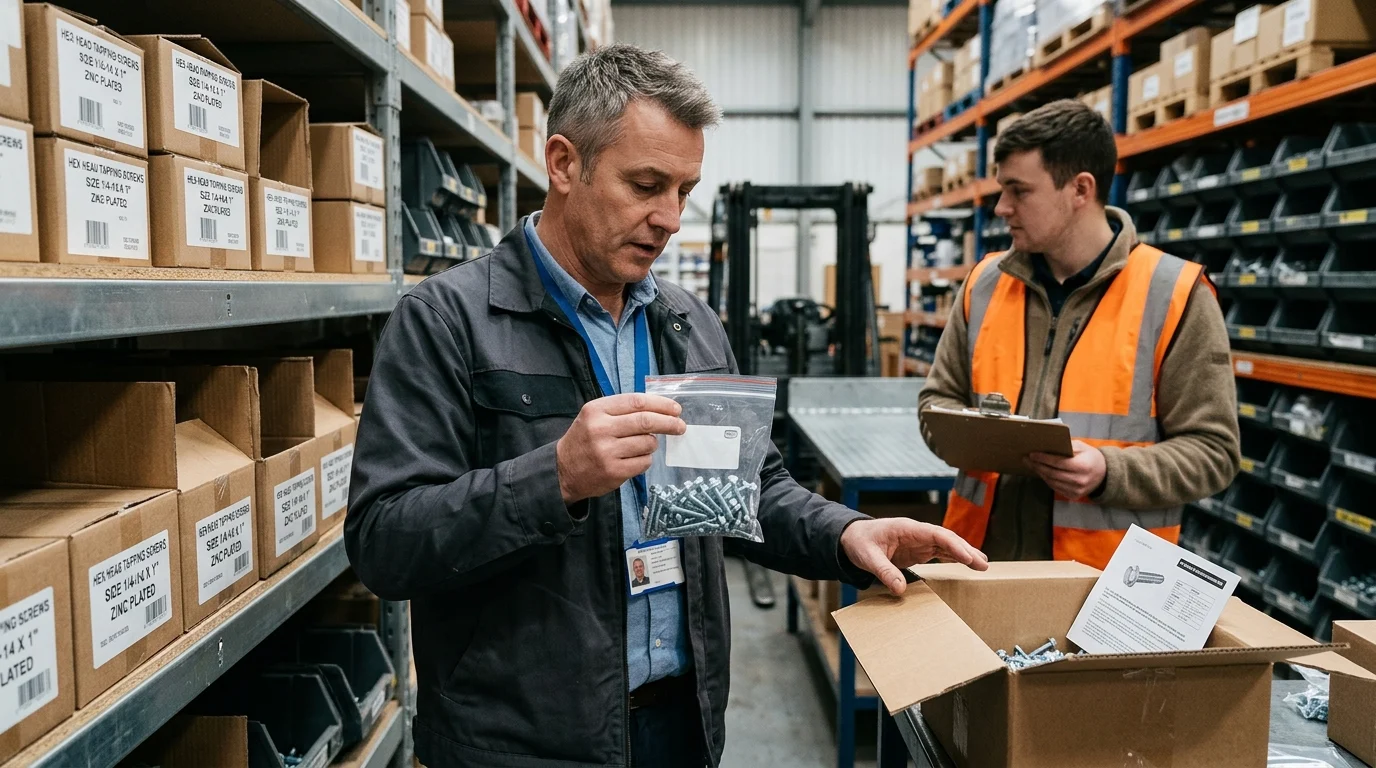
Not all buyers are operating under the same rules. The way I source for a Tier 1 assembly plant is vastly different from how I build a program for an aftermarket distributor or an MRO (Maintenance, Repair, and Operations) catalog. You have to know your market.
Your channel dictates your strategy. You need to align your specifications, packaging, and volume commitments with the end-user’s reality. A Hex Washer Head Self Tapping And Self Drilling Screw might look identical across different channels, but the business and quality program behind it varies wildly.
Matching specs to OEM, aftermarket, and MRO demand
OEM buyers demand rigid adherence to custom prints, Level 3 PPAP, and zero deviation. Aftermarket buyers often look for standardized DIN or ISO specifications that can fit multiple vehicle makes, prioritizing cost and availability. MRO buyers (who repair factory equipment or vehicles) usually buy in smaller quantities, so they need versatile screws in retail-ready packaging or kitted assortments rather than massive bulk bins.
RFQ, validation, and pilot order steps
A successful program follows a strict timeline. First, the RFQ and initial quoting phase. Second, the validation phase, where you request initial samples (ISIR) and test them in your specific metal substrates. Third, the pilot order—usually a small production run of 10,000 to 50,000 pieces to validate the supplier’s packaging, logistics, and mass-production consistency before signing a multi-year blanket order.
Key decision criteria before volume award
Before you sign the final volume award, evaluate the supplier’s financial stability, their capacity utilization (can they handle a sudden 20% spike in your demand?), and their communication speed. If a supplier takes five days to answer a technical question during the RFQ stage, imagine how long they will take to respond when there is a quality emergency on your assembly line.
FAQ: Common B2B Buyer Questions
Even with a solid sourcing strategy, specific technical and commercial questions always pop up during negotiations. I spend a lot of time fielding the same crucial questions from procurement teams trying to finalize their fastener programs and avoid costly mistakes.
To save you some time, I have compiled the most frequent inquiries I get regarding the Hex Washer Head Self Tapping And Self Drilling Screw. Whether you are finalizing a contract or just starting your supplier search, these answers should help clear the air.
Choosing between self-tapping and self-drilling for mixed substrates
Buyers often ask which to use when joining plastic to metal. If the top layer is plastic and the bottom is metal, a self-drilling screw is usually best, provided the drill point is long enough to clear the plastic before engaging the metal. If you are joining metal to metal and already have pre-punched holes for alignment purposes, a standard self-tapping screw is often cheaper and provides better thread engagement.
Typical MOQ, lead time, and packaging terms
For custom automotive runs, expect an MOQ of around 300,000 to 500,000 pieces per size. If it is a standard DIN/ISO dimension, suppliers might accept 100,000 pieces. Lead times typically run 4 to 6 weeks for production, plus an additional 4 to 6 weeks for ocean transit. Standard packaging is usually 15 kg to 20 kg per carton, stacked on standard Euro or US pallets, wrapped, and banded.
Required test reports and compliance files
When your shipment arrives, it should be accompanied by a comprehensive documentation packet. Expect to see a Material Mill Certificate (proving the steel grade), a heat treatment report (showing core and surface hardness), a plating thickness and salt-spray test report, and a dimensional inspection report. For OEM applications, the approved PPAP and IMDS submission numbers must also be clearly referenced.
Related reading: Automotive Fasteners
Key Takeaways
- Wholesale sourcing and supply-chain implications for Hex Washer Head Self Tapping And Self Drilling Screw
- Specifications, compliance, and commercial terms buyers should validate
- Actionable recommendations for distributors and procurement teams