Self Tapping Screw Sourcing to Reduce Industrial Lifecycle Cost
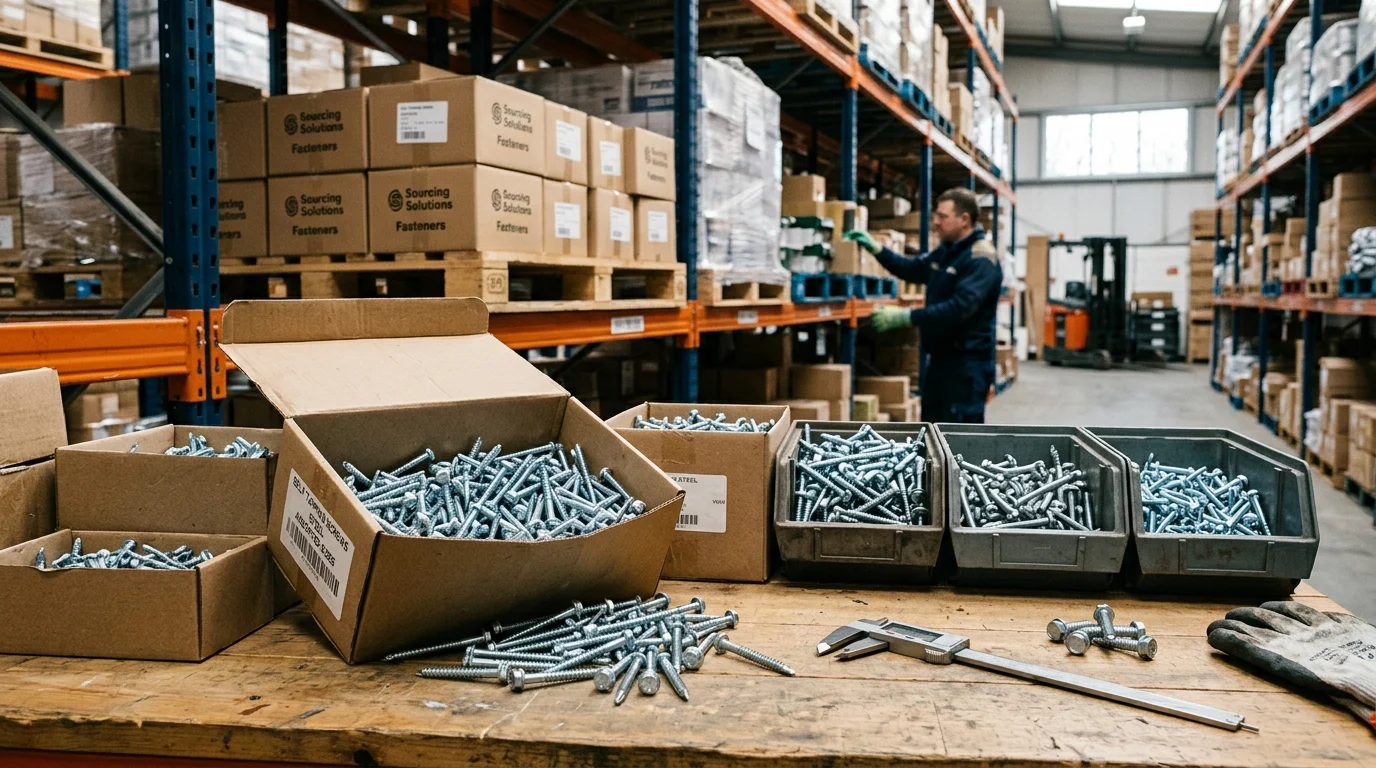
Why Self-Tapping Screw Sourcing Matters for Lifecycle Cost
Welcome to the reality of industrial procurement: the cheapest screw often ends up being the most expensive part on your assembly line. When I talk to procurement managers, many still fixate on the unit price of fasteners, forgetting that these tiny components hold together massive, expensive systems.
Taking a holistic view means looking at Lifecycle Cost. If a fraction-of-a-cent savings on a fastener results in stripped threads, jammed automated feeders, or worse, a product recall, that initial “savings” evaporates instantly. The true cost of a fastener includes the purchase price, the installation cost, and the cost of any potential failures.
In my experience, shifting the focus from unit cost to total cost of ownership transforms how we source. We need to evaluate the entire journey of the fastener, from the supplier’s wire drawing and cold heading processes to the end-user’s warranty claims. This is how you build a robust and cost-effective procurement strategy.
Link unit price to total lifecycle cost
It’s easy to look at a quote for $0.01 per piece and think you’ve found a great deal. However, if that screw has a 3% defect rate, the labor cost to manually extract and replace the broken screws on the assembly line will dwarf the initial purchase savings. To truly understand your spend, you must map the unit price directly to installation speed, tooling wear, and rework rates.
Quality-related failure, maintenance, and downtime costs
When a self-tapping screw fails in the field, the financial impact is severe. You aren’t just replacing a cheap piece of metal; you are paying for technician dispatch, replacement parts, and the reputational damage of downtime. I always remind buyers that a fastener failure in a critical industrial application can lead to thousands of dollars in warranty claims, making upfront quality assurance non-negotiable.
Prioritizing price, consistency, and supply security
While competitive pricing is always a goal, consistency and supply security should be your top priorities. A supplier who offers a slightly higher unit price but guarantees zero defects and holds buffer stock will ultimately save you money. Supply chain disruptions cost far more than a 5% premium on piece-price, so prioritize partners who offer stability.
Self-Tapping Screw Specifications with the Biggest Cost Impact
You can’t source effectively if you don’t understand the engineering behind the product. A Self Tapping Screw isn’t just a generic commodity; it’s a highly engineered piece of hardware designed to perform a specific mechanical function.
Specifying the wrong thread pitch, material, or drive type can drastically inflate your assembly costs. I’ve seen manufacturing lines slow down by 20% simply because a poorly specified screw drive kept camming out during installation, ruining bits and frustrating operators.
Let’s break down the physical specifications that dictate both the upfront cost from your manufacturer and the hidden costs on your factory floor. Every dimensional choice you make on your RFQ directly impacts your bottom line.
Thread, point, head, and drive effects on performance
The geometry of the screw dictates its installation speed. A Type A point might be cheaper to manufacture, but a Type AB point offers better performance in brittle materials. Similarly, upgrading from a standard Phillips drive to a Torx (star) drive might cost slightly more per unit, but it virtually eliminates cam-out, extending the life of your driver bits and speeding up assembly.
Material and finish selection by environment
Your choice of material and plating is a balancing act between corrosion resistance and cost. Standard carbon steel with a zinc-plated finish is economical for indoor use, but specifying it for marine environments guarantees premature failure. Upgrading to 304 or 316 stainless steel, or utilizing specialized coatings like Ruspert or Dacromet, increases the upfront cost but prevents catastrophic rust-related failures down the road.
Tolerance, hardness, pull-out, and torque requirements
If your supplier’s heat treatment process is inconsistent, you will end up with screws that are either too soft (stripping the threads) or too brittle (snapping the heads off). You must specify exact case hardness and core hardness requirements. High pull-out strength and consistent torsional strength ensure the screw performs reliably without damaging the host material.
How to Compare Suppliers Beyond Unit Price
So, you’ve got three quotes on your desk, and one is 15% cheaper than the others. It’s tempting to just issue the PO, right? But in Industrial Sourcing, that’s a rookie mistake that can lead to severe operational headaches.
Supplier selection is about evaluating a partner’s entire manufacturing ecosystem. A supplier with rock-bottom prices might be using outdated cold-heading machines, skipping essential sorting processes, or using substandard wire rod, leading to inconsistent batches that will wreak havoc on your automated assembly lines.
I always tell buyers to look under the hood. We need to assess their capacity, their quality management systems, and how they handle the inevitable hiccups in production. Here is how I compare suppliers holistically to ensure long-term success.
Capacity, tooling, quality systems, and lead time
A supplier’s true value lies in their infrastructure. Ask about their monthly tonnage capacity and whether they make their tooling in-house. In-house tooling means faster turnaround times for custom sizes. Furthermore, robust quality systems (like ISO 9001 or IATF 16949) and realistic, transparent lead times are far more valuable than a supplier who over-promises and under-delivers.
MOQ, customization, and private label considerations
Not all suppliers are willing or able to accommodate custom head marks or specialized private label packaging without massive Minimum Order Quantities (MOQs). If your business model relies on dropping customized, branded boxes straight to retail or distribution networks, you need a partner whose packaging lines are as flexible as their manufacturing lines.
Supplier benchmarking by price, defects, compliance, and service
To make an objective decision, I use a weighted benchmarking system.
| Evaluation Criteria | Weight | What to Look For |
|---|---|---|
| Landed Price | 30% | Total cost including freight, duties, and packaging. |
| Defect Rate (PPM) | 30% | Historical parts-per-million defect rate; optical sorting capabilities. |
| Compliance & QA | 20% | ISO certifications, in-house lab testing (salt spray, torque). |
| Service & Comm. | 20% | English proficiency, response time, willingness to hold buffer stock. |
Required Compliance and Quality Controls
Quality control isn’t just a box to check; it’s your primary defense against catastrophic failure and skyrocketing lifecycle costs. If a batch of screws fails a salt spray test after they’ve been installed in outdoor telecom enclosures, you’re looking at a nightmare scenario of field replacements.
I always insist on rigorous, documented compliance. Whether you’re dealing with DIN, ISO, JIS, or ASTM standards, your supplier must prove they can consistently meet the metallurgical and dimensional tolerances required for your specific application.
You have to build a quality framework into your purchasing agreement. Let’s look at the specific controls, tests, and certifications you need to demand before you even think about paying a deposit or issuing a mass production order.
Standards, certifications, and test reports to request
Never accept verbal assurances of quality. Demand full material certificates (often called 3.1 certs) that trace the chemical composition of the raw wire. Depending on your industry, you should also require documented reports for salt spray testing (to verify plating thickness and corrosion resistance), case depth testing, and torsional strength validation.
Incoming inspection, testing, and traceability requirements
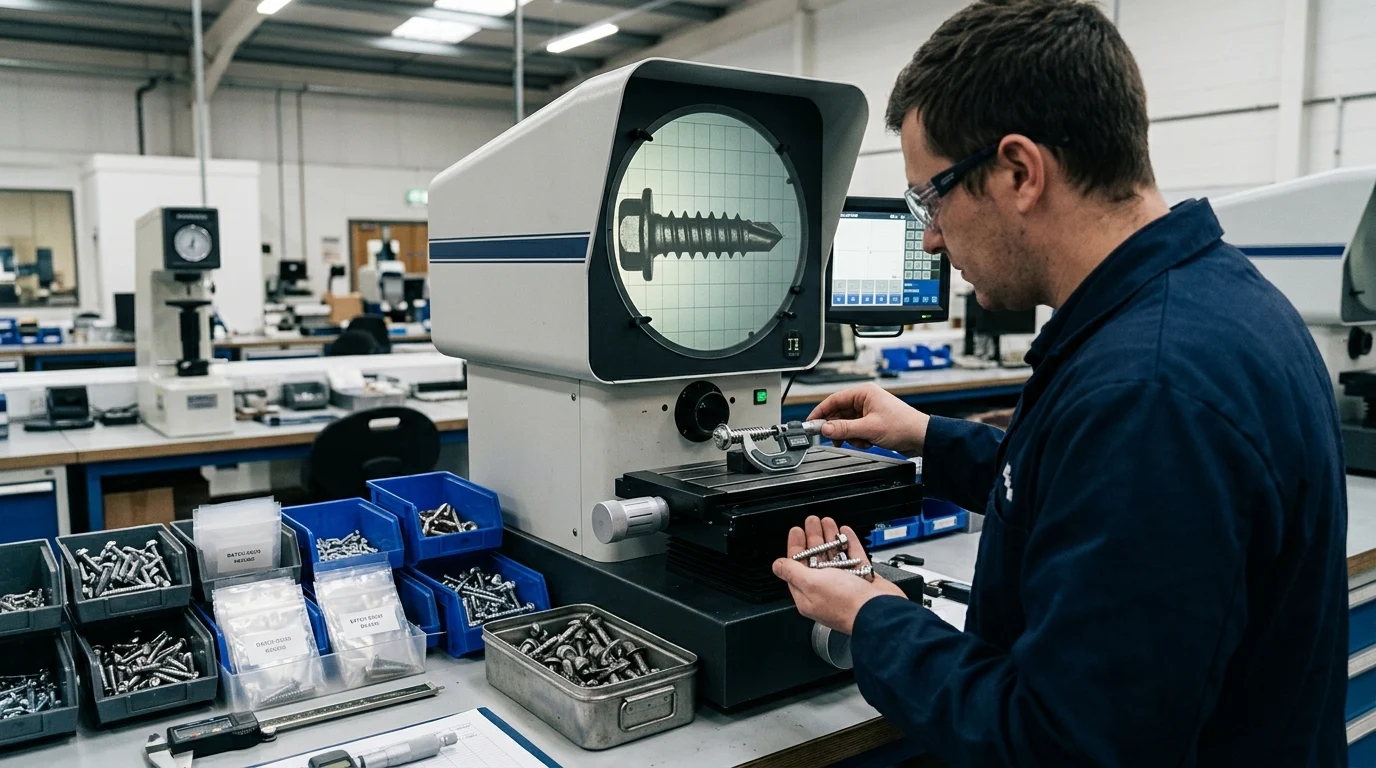
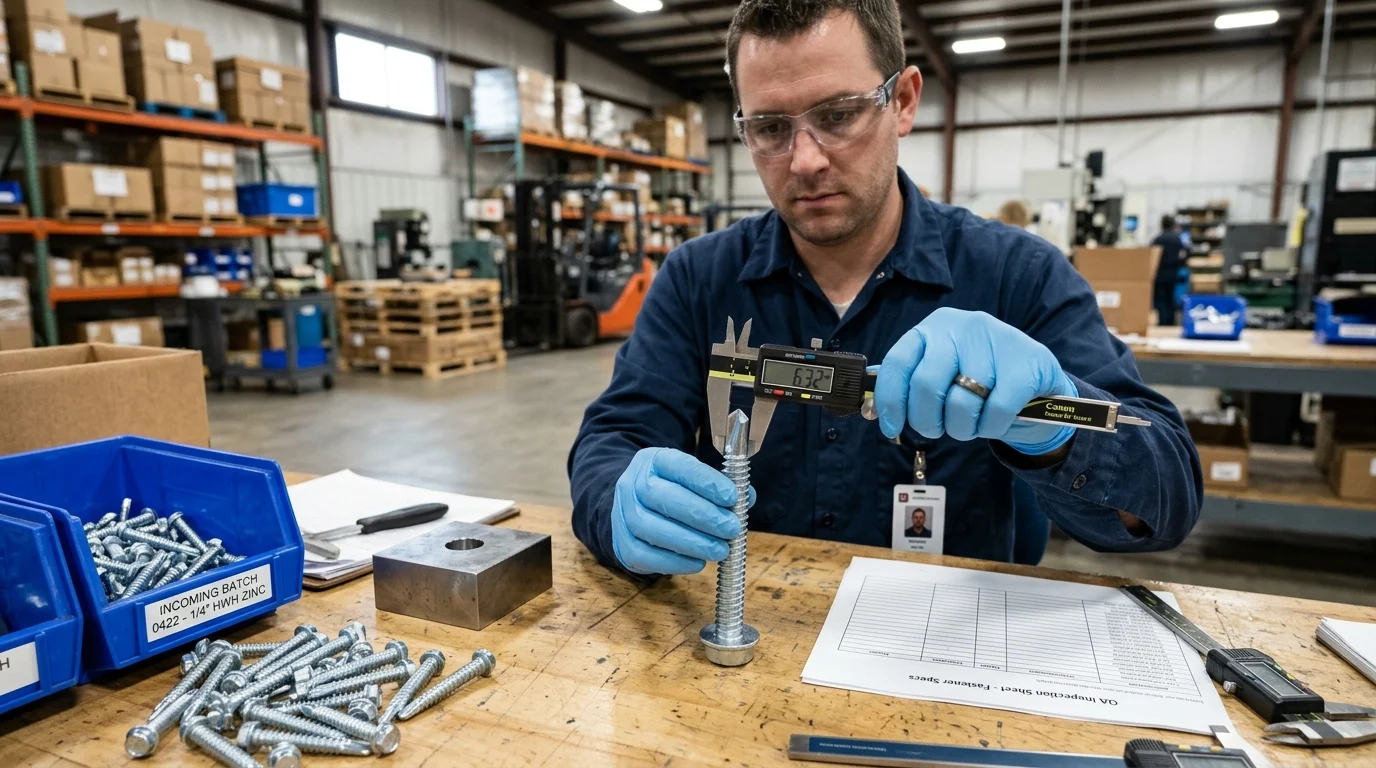
Even with the best suppliers, you need an incoming inspection protocol. Utilize AQL (Acceptable Quality Limit) sampling to check dimensions, thread pitch, and drive concentricity upon arrival. Furthermore, ensure the supplier uses a strict lot-numbering system. If a defect is found on the line, you must be able to trace it back to the exact machine and raw material batch.
Common batch failures and prevention steps
Understanding how screws fail helps you prevent defects.
| Common Failure | Root Cause | Prevention Requirement |
|---|---|---|
| Heads snapping off | Improper heat treatment (too brittle) | Require strict core/case hardness testing. |
| Threads stripping | Wire material too soft or shallow threads | Specify thread roll tolerances and material grade. |
| Premature rusting | Inadequate zinc plating or poor passivation | Demand 48-96 hour salt spray test reports per batch. |
How Packaging, MOQ, and Logistics Affect Landed Cost
Let’s talk about the physical movement of goods. You might negotiate a fantastic Factory-Direct price on the fasteners themselves, but if your logistics and packaging strategy is sloppy, your landed cost will destroy your expected margins.
Fasteners are heavy, dense, and cheap per unit, which means freight and handling make up a disproportionately large percentage of your total cost. Shipping half-empty containers, paying for air freight because of poor planning, or using flimsy packaging that breaks during transit are classic margin killers.
Furthermore, Minimum Order Quantities (MOQs) dictate your inventory holding costs. Buying two years’ worth of stock just to get a lower unit price ties up critical cash flow. We need to balance these logistical elements carefully to optimize the real cost.
Packaging formats for handling and resale efficiency
How the screws are packed matters immensely. Bulk packing in 25kg woven bags is cheap but a nightmare for factory workers to handle. Transitioning to small, color-coded cardboard boxes packed into reinforced export cartons on standard fumigated pallets reduces warehouse handling time, prevents transit damage, and makes inventory counting significantly easier.
Freight mode, container planning, and Incoterms
Because screws are dense, you will almost always hit a shipping container’s weight limit before you fill its volume. Proper container planning ensures you maximize the payload without incurring overweight fines. Additionally, buying on FOB (Free on Board) terms usually gives you better control over your ocean freight costs compared to letting the supplier manage it via CIF (Cost, Insurance, and Freight).
SKU consolidation, MOQ tiers, and buffer stock strategy
To navigate high MOQs, look for opportunities to consolidate SKUs. If you use three slightly different lengths of a #8 screw, see if engineering can standardize on one length. For critical parts, negotiate a buffer stock agreement where the supplier produces a large batch to achieve economies of scale but holds the inventory in their warehouse, shipping and billing you on a monthly release schedule.
A Practical Sourcing Process for Selecting the Right Supplier
Having a structured sourcing process takes the emotion and guesswork out of procurement. It’s not just about sending an email and asking for a price list; it’s about building a resilient Supply Chain that can scale with your business needs over the next decade.
I like to treat the sourcing journey as a funnel. You start wide, vetting multiple factories, and narrow it down through rigorous RFQs, sample testing, and facility audits until you find a partner capable of long-term reliability and consistent communication.
Let’s walk through the exact steps I use to take a fastener sourcing project from the initial specification phase all the way to a signed, long-term supply agreement with a trusted manufacturer.
From sample validation to long-term supply agreement
Never jump straight to a mass order. Start with a paid sample run, ideally off the actual production tooling. Once engineering validates the samples, move to a small pilot run to test their packaging and logistics. Only when the pilot run passes incoming QC should you lock in a 12-month supply agreement that dictates pricing, lead times, and defect penalty clauses.
RFQ fields for specifications, packaging, testing, and delivery
A vague RFQ yields vague, incomparable quotes. Your RFQ must be exhaustively detailed. Include the exact DIN/ISO standard, material grade, plating thickness (in microns), specific drive type, required head marks, packaging dimensions, and the target Incoterm (e.g., FOB Shanghai). The more detail you provide, the faster you can weed out unqualified brokers.
Supplier scorecards and cost review process
Sourcing doesn’t end when the PO is issued. Implement a quarterly supplier scorecard that tracks on-time delivery rates, PPM defect rates, and responsiveness to issues. Conduct an annual cost review to ensure their pricing remains competitive with raw material indexes (like global steel prices) and currency exchange fluctuations.
Common B2B Buyer Questions on Self-Tapping Screw Sourcing
Over the years, I’ve fielded hundreds of questions from procurement teams trying to navigate the fastener market. The challenges are surprisingly universal, whether you’re buying for automotive assembly, construction distribution, or consumer electronics manufacturing.
Buyers constantly wrestle with pricing anomalies, pushback on MOQs, and frustrating lead times. It helps to know what is “normal” in the industry so you can negotiate from a position of strength and set realistic expectations for your internal stakeholders.
Here are a few of the most common questions I hear, along with some practical, no-nonsense answers to help you navigate your next sourcing cycle.
How to assess whether a low-cost quote is sustainable
If a quote comes in 30% below the market average, be highly suspicious. Check the global price of steel wire rod; if the quoted price is barely above raw material costs, the supplier is likely cutting corners on heat treatment, skipping optical sorting, or planning to raise prices immediately after the first order. Always ask for a cost breakdown.
Realistic MOQs for custom sizes, finishes, or packaging
For standard DIN/ISO sizes, MOQs can be as low as 100,000 pieces or a few hundred kilograms. However, if you require a custom head shape, a proprietary thread design, or a specialized salt-spray resistant coating, expect MOQs to jump to 500,000 pieces or 1-2 tons. Factories need this volume to justify the setup time on the cold heading machines.
Typical timelines for sampling, production, and replenishment
For a custom self-tapping screw, expect 15-20 days to cut new tooling and produce initial samples. Once samples are approved, mass production typically takes 30-45 days, depending on their plating schedule. Add another 30-40 days for ocean transit. Therefore, a realistic lead time for a new custom fastener is about 90-110 days from PO to warehouse floor.
Key Takeaways for Reducing Lifecycle Cost
We’ve covered a lot of ground, from the micro-details of thread geometry to the macro-economics of container shipping. The overarching theme is clear: strategic sourcing requires looking far beyond the invoice price to understand how a simple piece of hardware affects your entire business.
Reducing the total cost of ownership is an ongoing process of optimization. It requires tight collaboration between your engineering, procurement, and quality assurance teams, as well as a transparent, communicative relationship with your overseas supplier.
As you prepare for your next procurement cycle, keep these final thoughts in mind to ensure you are maximizing value, minimizing risk, and keeping your assembly lines running smoothly.
Decisions that deliver the fastest savings
The quickest way to save money isn’t beating up your supplier for a half-cent discount. The fastest savings come from SKU consolidation, upgrading to optical sorting to eliminate downtime on your automated assembly lines, and optimizing your packaging to maximize shipping container weight limits.
Balancing landed cost, quality assurance, and margin
Procurement is a balancing act. If you squeeze the supplier too hard on price, they will inevitably squeeze the quality—perhaps by shortening the heat treatment cycle or using thinner plating. You protect your margins not by buying the cheapest screw, but by buying the most reliable screw at a fair market price, thereby eliminating rework and warranty claims.
Final checklist before placing an order
Before you send that PO, ensure you have:
- A fully detailed mechanical drawing with tolerances.
- Approved physical samples from the actual production line.
- Agreed-upon AQL levels for incoming inspection.
- A clear understanding of the packaging format and palletization.
- Written confirmation of lead times and Incoterms.
Related Reading: Self Tapping Screw
Key Takeaways
- Wholesale sourcing and supply-chain implications for Self Tapping Screw
- Specifications, compliance, and commercial terms buyers should validate
- Actionable recommendations for distributors and procurement teams