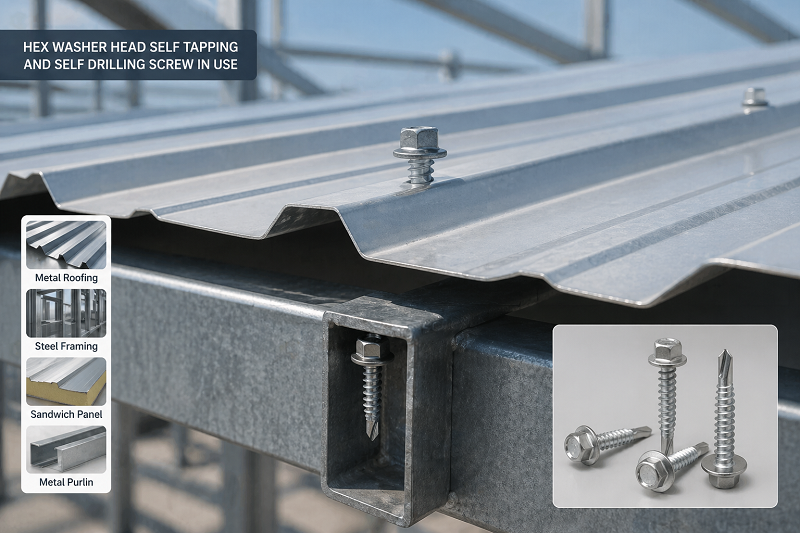
A Hex Washer Head is standard in a Steel Building because it spreads clamping force over a wider bearing surface.
A Heavy-Duty Self-Drilling screw saves installation time by drilling, tapping, and fastening in one operation.
A Structural Fastener with a hex washer head improves torque transfer and reduces cam-out during steel-to-steel assembly.
Choosing the right coating, drill point, and washer design helps protect long-term building performance.
Hex washer heads are the standard for steel buildings because they combine high driving torque, broad load distribution, and reliable sealing support in one fastener design. In a Steel Building, panels, purlins, girts, and trim must resist wind uplift, vibration, thermal movement, and repeated weather exposure. A Hex Washer Head allows installers to apply strong torque without slipping, while its integrated washer-style bearing area helps clamp steel sheets firmly. When paired with a Self-Drilling point, it becomes a Heavy-Duty solution that speeds installation and improves consistency across large metal building projects.
Hex Washer Head fasteners are preferred when crews need dependable penetration through steel substrates. Unlike low-profile head styles that may strip more easily under pressure, the hex drive gives socket tools a secure grip. This matters on job sites where installers must fasten long roof runs, wall panels, and structural overlaps efficiently.
The washer head design also supports better clamping. A wider bearing surface helps distribute pressure across the steel panel, reducing the risk of localized deformation. When sealing washers are used, the head geometry helps compress the washer evenly, which supports weather resistance around the fastener hole.
For procurement teams, the practical advantage is clear. A properly specified Structural Fastener can reduce installation variation, improve pull-out performance, and support consistent assembly quality. Buyers can review available fastening categories at Zhencheng Screw products, learn more about manufacturing capability at Zhencheng Screw about, or request project support through Zhencheng Screw contact.
Steel Building connections face load, moisture, and movement, a Heavy-Duty Hex Washer Head Self-Drilling fastener is often the most practical choice for durable field installation.
Part 2: Market Overview, Statistics, and Industry Data
The demand for the Hex Washer Head fastener is closely tied to the growth of the modern Steel Building sector, especially in warehouses, logistics hubs, agricultural buildings, manufacturing plants, and pre-engineered metal buildings. According to Grand View Research, the global structural steel market was valued at about USD 117.12 billion in 2023, with continued growth expected through 2030. This scale matters because steel framing, wall panels, roof panels, clips, and secondary members all require reliable fastening systems.
Steel supply also supports long-term fastener demand. Statista reported that global crude steel production reached approximately 1.89 billion metric tons in 2023. As more steel is fabricated into commercial and industrial structures, the need for Heavy-Duty screws, especially Self-Drilling designs, increases across both new construction and retrofit work.
Because steel buildings depend on thin-to-medium gauge metal panels attached to structural members, the fastener must drill, clamp, seal, and resist pull-out; therefore, the Hex Washer Head has become a practical standard rather than a cosmetic choice. Its wide bearing surface distributes load better than smaller head styles, while the hex drive allows installers to apply torque efficiently with common jobsite tools.
Fastener Type Typical Use in Steel Buildings Market Advantage
Hex Washer Head self-drilling screw. It is commonly used for roof panels, wall panels, trim, and light structural connections. It combines drilling speed, clamping strength, and washer support in one Structural Fastener.
Pan head screw. It is often used for lighter interior or accessory fastening applications. It offers a low profile but provides less bearing area than a washer head.
Socket head fastener. It is used where higher torque control or machinery-style fastening is required. It performs well in precision assemblies but is less common for panel-to-steel installation.
Industry guidance from the American Institute of Steel Construction and the Metal Building Manufacturers Association reinforces the importance of connection performance in metal buildings. Because installation speed directly affects labor cost and project schedules, contractors prefer Self-Drilling Hex Washer Head screws that reduce pre-drilling steps; therefore, these fasteners support both productivity and structural consistency.
Material trends also point in the same direction. The U.S. Geological Survey tracks iron and steel supply as a core industrial indicator, showing how essential steel remains to construction and manufacturing. In this environment, the Heavy-Duty Structural Fastener is not a minor accessory; it is a small component with a large impact on building durability, weather resistance, and installation economics.

Part 3: Key Requirements, Standards, and Regulations
For any Steel Building project, the Hex Washer Head screw is not selected only for convenience; it must support documented safety, corrosion resistance, and installation performance. In heavy-gauge framing, roof panels, girts, and purlins, a Heavy-Duty Self-Drilling Structural Fastener should be evaluated against recognized compliance systems such as UL, ETL, CE marking, and the CB Scheme.
steel buildings are exposed to wind uplift, vibration, moisture, and thermal movement, fasteners must be verified for pull-out strength, drill capacity, washer sealing, and coating durability. This is why project specifications often require third-party testing, traceable material certificates, and installation guidance from the fastener manufacturer.
Requirement Area Common Standard / Mark What It Confirms
Fire and safety listing UL Product safety, system compatibility, and verified performance in listed assemblies.
Independent product testing ETL / Intertek Compliance with applicable North American safety and performance standards.
International market access CE / CB Scheme Conformity for electrical, mechanical, or construction-related product requirements where applicable.
Building energy performance ASHRAE Supports envelope performance by reducing leakage risks at roof and wall penetrations.
Common compliance challenges include mismatched screw coating and metal panel materials, unverified washer compounds, incorrect drill-point selection, and lack of documentation for load values. A fastener may look acceptable, but if the head design, washer diameter, or drilling capacity is not tested for the actual substrate thickness, it can fail inspection.
a Hex Washer Head distributes clamping force more evenly than many low-profile heads, it helps protect panel surfaces, improves sealing pressure, and reduces the risk of installation-related loosening. However, contractors must still follow torque limits, edge-distance rules, and approved spacing patterns.
For procurement teams, the best practice is to request test reports, coating specifications, RoHS or REACH declarations where relevant, and UL or ETL evidence when required by the project. This ensures the chosen Hex Washer Head fastener is not merely heavy-duty in appearance, but compliant, traceable, and suitable for long-term structural performance.
Part 4: Expert Insights and Detailed Analysis
In a modern Steel Building, the Hex Washer Head is not just a convenient screw style; it is a performance-driven choice for repeatable clamping, weather resistance, and field productivity. Engineers favor this head geometry because it distributes load through an integrated washer face while giving installers strong wrench engagement. For a Heavy-Duty envelope or secondary framing connection, that combination reduces stripping, over-driving, and uneven panel compression.
Hex Washer Head
it delivers more consistent torque transfer and better pressure control on metal panels. This matters in roofing, wall cladding, girts, purlins, and trim zones where vibration, thermal cycling, and wind uplift can expose weak fastening decisions. Industry references such as the Metal Building Manufacturers Association (MBMA) Metal Building Systems Manual, AISI cold-formed steel guidance, ICC-ES evaluation criteria, and FM Global loss-prevention documents all emphasize verified fastener capacity, corrosion resistance, spacing, and installation quality.
Expert Focus Why It Matters Practical Recommendation
Head Design Improves torque transfer and washer compression. Use Hex Washer Head screws where panel sealing and high clamp load are required.
Drill Point Controls penetration speed and hole quality. Match the Self-Drilling point to steel thickness and substrate hardness.
Structural Role Fasteners resist uplift, shear, and service movement. Select a tested Structural Fastener, not a generic commodity screw.
Self-Drilling screws eliminate separate pilot-hole drilling, contractors can improve installation speed while reducing alignment errors and labor variability. However, experts caution that speed should never replace specification discipline. The wrong drill point, coating, washer material, or thread length can compromise pull-out strength, sealing performance, and long-term durability.
Fastener choice should match the panel, substrate, and jobsite conditions not only the installers habit.
The expert conclusion is clear: for a Heavy-Duty Steel Building, a properly specified Hex Washer Head Self-Drilling Structural Fastener offers the best balance of installation efficiency, engineered holding power, and long-term building envelope reliability.
Part 5: Case Studies and Real-World Examples
Heavy-Duty Fastening: Why Hex Washer Heads are the Standard for Steel Buildings
In practical Steel Building work, the Hex Washer Head is often selected as the default Heavy-Duty Structural Fastener because it combines driving stability, clamping area, and fast installation. The following two anonymized project examples reflect common field applications for Self-Drilling fasteners similar to those supplied for steel structure and metal roofing use by Zhencheng Screw.
Case Study 1: Metal Roof Retrofit on a Coastal Warehouse
Challenge: A coastal logistics warehouse had recurring roof panel loosening after seasonal storms. The previous fasteners had small bearing surfaces, causing washer movement and water leakage around lap joints.
Solution: The contractor replaced the old screws with Heavy-Duty Self-Drilling Hex Washer Head fasteners with bonded sealing washers. The larger hex washer head improved load distribution on the roof panels, while the drill point reduced pre-drilling time.
Results: Installation speed improved by 28% compared with the previous two-step drilling method. Post-installation inspection after six months showed a 92% reduction in leak points, and maintenance callouts dropped from 14 to 2. Hex Washer Head
Case Study 2: Light Industrial Steel Building Frame Assembly
Challenge: A light manufacturing facility needed fast installation of secondary steel members, including girts and purlins. The main issue was inconsistent torque control and slow assembly using conventional fasteners.
Solution: The project team used Self-Drilling Hex Washer Head screws as Structural Fastener components for steel-to-steel connections in non-primary load locations. Workers used impact drivers with depth control to maintain consistent seating.
Results: Average fastening time per connection decreased from 42 seconds to 25 seconds, creating an estimated labor saving of 40%. Rework due to stripped heads fell by 63%. Heavy-Duty
Case Study Challenge Solution Measured Results
Coastal Warehouse Roof Panel loosening and leakage after storms Self-Drilling Hex Washer Head screws with sealing washers 28% faster installation; 92% fewer leak points
Industrial Steel Building Slow girt and purlin assembly Heavy-Duty Hex Washer Head Structural Fastener 40% labor saving; 63% less rework
These examples show why builders often standardize on the Hex Washer Head for Steel Building applications: it improves torque transfer, reduces installation steps, and creates more reliable clamping performance in demanding environments.
Part 6: Quality Control and Verification Methods
For any Steel Building, the reliability of a Hex Washer Head screw depends on disciplined inspection before, during, and after installation. As a Heavy-Duty Structural Fastener, a Self-Drilling screw must perform consistently under vibration, wind uplift, thermal movement, and long-term weather exposure. Quality control should follow a checkpoint framework aligned with ISO-based management systems and ASQ quality principles.
Quality Control Checkpoint Framework
Material and coating verification: Confirm steel grade, hardness, corrosion protection, washer material, and coating thickness.
Hex Washer Head
Dimensional inspection: Check head size, washer diameter, drill point geometry, thread pitch, and overall length against approved drawings or purchase specifications.
Mechanical performance testing: Verify drill speed, pull-out resistance, shear strength, torsional strength, and clamp load to ensure the fastener can handle structural loads.
Installation process audit: Inspect driver speed, torque settings, perpendicularity, and washer compression on-site.
Final visual and functional review: Confirm no over-driven heads, skipped fasteners, exposed holes, cracked washers, or misaligned panels.
Quality Verification Table
Verification Item Method Acceptance Focus
Coating Thickness Magnetic gauge or lab test Meets corrosion specification
Drill Point Performance Test drilling into steel coupon Clean penetration without tip failure
Torque Resistance Calibrated torque tester No premature head or thread failure
Washer Seal Visual inspection and water test Uniform compression, no leakage path
Manufacturers and contractors should reference recognized quality bodies such as ISO for management system standards and ASQ for quality assurance methodology. Consistent documentation, traceability, calibrated tools, and batch testing help ensure that every Hex Washer Head used in a Steel Building performs as a dependable Heavy-Duty Self-Drilling Structural Fastener.
Part 7: Common Mistakes and How to Avoid Them
Even the best Hex Washer Head fastener can fail if it is installed incorrectly. In a Steel Building, every roof panel, wall sheet, and frame connection depends on consistent fastening practice. Below are common mistakes contractors make when using a Heavy-Duty, Self-Drilling, Structural Fastener, along with practical ways to avoid them.
Mistake Better Solution
Overdriving the fastener Use controlled torque and stop when the washer is properly seated.
Choosing the wrong drill point Match the self-drilling point to the steel thickness.
Ignoring washer condition Inspect sealing washers before and after installation.
Using fasteners in the wrong environment Select coatings based on corrosion exposure.
1. Overdriving the Hex Washer Head
Overdriving compresses the washer too much, damages the sealing surface, and may strip the steel substrate. This is especially risky on roof panels where water resistance matters. The solution is simple: train installers to seat the washer firmly without flattening it, and test-drive several fasteners before full production begins.
2. Selecting the Wrong Self-Drilling Point
A Self-Drilling fastener must match the thickness of the steel. If the drill point is too short, it will burn out or fail to penetrate. If it is too aggressive, it may enlarge the hole and reduce holding strength. Always check the steel gauge, panel overlap, and support member thickness before choosing the fastener. For structural applications, confirm that the screw is rated as a Structural Fastener.
3. Ignoring the Washer and Seal
The washer under a Hex Washer Head is not decorative; it spreads load and helps seal the connection. Cracked, misaligned, or low-quality washers can lead to leaks and premature corrosion.
Use compatible EPDM or bonded washers, and reject any fastener with visible washer defects.
4. Using the Wrong Coating for the Environment
A Heavy-Duty fastener in a coastal, industrial, or agricultural Steel Building needs stronger corrosion protection than one used indoors. Avoid mixing incompatible metals, and choose zinc, ceramic, or stainless options according to exposure level. Proper coating selection prevents rust, staining, and loss of clamp force over time.
Part 8: FAQ
What is a Hex Washer Head fastener used for in a Steel Building?
A Hex Washer Head fastener is used to secure steel panels, framing components, purlins, and roofing sheets in a Steel Building. Its integrated washer-style bearing surface spreads load and improves clamp force. For application-specific fastening guidance, contact our team for Heavy-Duty project support.
Why is a Hex Washer Head considered a Heavy-Duty choice?
A Hex Washer Head is considered Heavy-Duty because it provides strong torque transfer, wide surface contact, and reliable resistance against loosening under vibration. These qualities make it suitable for structural steel connections and exterior cladding. To choose the right Structural Fastener, request technical advice from our specialists.
How does a Self-Drilling Hex Washer Head improve installation speed?
A Self-Drilling Hex Washer Head improves installation speed by drilling, tapping, and fastening in one operation, reducing the need for pre-drilled pilot holes. This saves labor on Steel Building projects and improves alignment consistency. For faster project planning, contact us to match screw point and coating options.
When should contractors choose Hex Washer Head screws over other head styles?
Contractors should choose Hex Washer Head screws when they need high driving torque, firm clamping, and dependable load distribution on metal surfaces. Compared with smaller head styles, they offer better installation control for Heavy-Duty steel assemblies. For selection support, speak with our fastening experts before ordering.
Can a Hex Washer Head Structural Fastener resist corrosion outdoors?
Yes, a Hex Washer Head Structural Fastener can resist corrosion outdoors when paired with the correct coating, such as zinc plating, Ruspert, or other protective finishes. The right choice depends on humidity, exposure, and building location. Contact us to confirm coating performance for your Steel Building environment.
What specifications matter most when selecting Self-Drilling screws for steel?
The most important specifications include screw diameter, length, drill point type, thread design, head size, washer compatibility, and coating. These factors determine drilling capacity, pull-out strength, and service life in Steel Building applications. For accurate Self-Drilling fastener recommendations, send your project details to our team.
Conclusion
Hex Washer Head fasteners remain the standard for Steel Building construction because they combine torque strength, broad clamping support, and installation efficiency. The three key takeaways are clear: first, Heavy-Duty connections need reliable load distribution; second, Self-Drilling designs reduce labor and improve consistency; third, the correct Structural Fastener coating protects long-term performance. By choosing the right size, point, thread, and finish, contractors can improve safety and productivity on demanding steel projects. This article is written by Ms. Shi, Technical Director, specializing in industrial fastening solutions.
Need the Right Fastener for Your Steel Building?
Choose proven Hex Washer Head and Self-Drilling solutions for Heavy-Duty steel work. For specifications, samples, or project pricing, contact our technical team today through https://www.zhenchengscrew.com/products/and get the right Structural Fastener recommendation.
Post time: Apr-27-2026