For steel framing, contractors prefer the Philip Flat Head Self Tapping And Self Drilling Screw because it shortens installation time, creates a flush finish, reduces rework, and supports consistent fastening across large projects. In practical terms, one screw performs 2 functions: it drills and fastens in a single operation. That matters on jobs with 1,000+ m of partitions, ceilings, backing frames, or light-gauge assemblies, where every second per connection adds up. The Phillips recess remains common because crews already carry compatible bits in 25 mm and 50 mm lengths, so onboarding is simple. The flat head is preferred because it seats cleanly against thin steel and sheet-facing materials, so surfaces stay even for the next layer. The self-drilling point is valuable because it can penetrate light steel without a separate pilot step, so labor flow becomes faster and more predictable. Buyers also like these screws because standardized diameters such as 3.5 mm, 4.2 mm, and 4.8 mm, plus lengths like 19 mm, 25 mm, and 32 mm, make estimating and replenishment easier in 2026.
TL;DR
1 step drilling plus fastening reduces cycle time versus a separate pilot-hole process on light-gauge steel framing.
3 common diameters of 3.5 mm, 4.2 mm, and 4.8 mm help buyers match load and material thickness.
3 frequent lengths of 19 mm, 25 mm, and 32 mm cover many framing and board attachment tasks.
1 flush head profile supports smoother panel seating, better trim alignment, and fewer visible bumps across finished areas.
2026 sourcing priorities focus on coating consistency, drill capacity, packaging count per 1 box, and fewer on-site replacements.
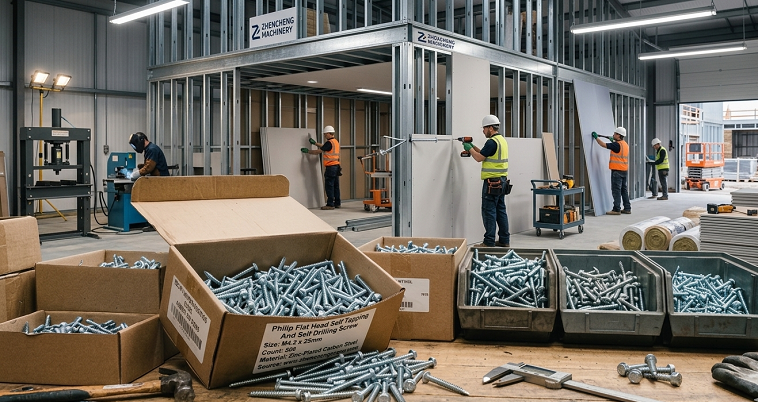
Why this screw type fits steel framing so well
Steel framing rewards speed, repeatability, and clean fit-up. That is exactly why contractors keep choosing Phillips flat head self-drilling screws for commercial and industrial work. The combination is practical. The Phillips drive is familiar to crews, the flat head helps the screw sit flush, and the self-drilling point can cut into thin steel sections without a separate operation. These are not small gains. On high-volume projects with 10,000 pieces to 100,000 pieces of fasteners, even a time reduction of 2 s per connection can produce meaningful labor savings.
Contractors also like predictability. A fastener that drills inconsistently slows the line. A head that does not seat evenly creates surface irregularities. A drive that cams out too often wastes bits and damages finishes. So the reason this category remains popular is simple: it supports steady production. The connection is fast, the installed result is neat, and inventory planning is straightforward.
If you are reviewing options for steel framing supply, you can explore product categories at https://www.zhenchengscrew.com/products/. For B2B buyers, that matters because comparing diameter, length, head style, and coating side by side makes procurement decisions faster.
1. Faster installation on repetitive work
The biggest reason for preference is speed. A self-drilling point saves a step because it can form its own entry in many light-gauge steel members, so installers do not pause to switch tools or pre-drill every connection. That matters in track-to-stud fastening, channel attachment, board support framing, and accessory installation. The result is a smoother workflow across 8 h to 10 h shifts.
Crews value this because rhythm affects productivity. When an installer can align, drive, and move on, throughput improves. That is especially true on large tenant build-outs, warehouses, and modular assemblies where uniform spacing may run across 20 m, 50 m, or more.
2. Flat heads improve finish quality
A flat head is preferred when the next layer needs an even surface. In steel framing systems, proud fasteners can interfere with sheathing, panels, trims, brackets, or finishing materials. Contractors choose flat heads because the screw can sit closer to flush, so attached materials rest more evenly.
This is not only cosmetic. Better seating reduces rocking and local stress at the attachment point. Installers appreciate that because cleaner fit-up often means less adjustment later in the sequence.
The importance of drive style in real jobsite conditions
The Phillips recess still matters in 2026. Many procurement teams ask whether newer drive systems should replace it entirely. In some applications, alternatives have advantages, but the Phillips drive remains common because bits are easy to source, drivers are already configured for it, and crews know the feel of correct engagement. This familiarity reduces transition time. A drive system that everyone already understands is useful because training takes fewer hours, so new labor can become productive faster.
There is also a supply-chain angle. Contractors often run mixed fleets of tools across multiple crews and subcontractors. Standardized bits in 25 mm and 50 mm lengths are easy to stock, and replacement can happen through many channels. That is one reason buyers continue to specify the Philip Flat Head Self Tapping And Self Drilling Screw family for framing packages.
Of course, good installation practice still matters. Correct RPM, steady pressure, and proper perpendicular alignment help avoid stripping. But when the screw geometry and point are matched to the steel thickness, the process is efficient because the fastener is engineered for penetration and seating together, so crews spend less time correcting mistakes.

Why contractors think in systems, not single parts
B2B contractors do not evaluate a screw in isolation. They think in terms of systems: framing member thickness, board type, coating exposure, installation speed, expected finish, and total delivered cost per 1 project. This system mindset explains the long-term popularity of self-drilling flat head screws.
Drill capacity matters because the point must match the steel thickness, so the screw penetrates without excessive heat build-up.
Head geometry matters because flush seating affects the next trade, so panel and trim alignment stay cleaner.
Coating performance matters because storage, handling, and service conditions vary, so appearance and corrosion resistance remain more stable.
Dimensional consistency matters because automated or semi-repetitive workflows depend on uniform behavior, so operators can maintain pace.
Packaging count matters because site logistics are real, so replenishment can be planned by crew, floor, or zone.
This is also why buyers ask detailed specification questions before ordering. They are not only purchasing metal hardware. They are purchasing installation reliability, labor efficiency, and schedule protection.
Common specification ranges buyers compare
Although exact project requirements vary, B2B buyers often compare the following ranges when selecting a Philip Flat Head Self Tapping And Self Drilling Screw for framing:
Diameter: 3.5 mm to 4.8 mm
Length: 19 mm to 38 mm
Head type: flat head for near-flush seating
Drive: Phillips for field familiarity
Application: light-gauge steel framing, channels, tracks, accessories, and attached layers
Buyers should match the screw to the steel gauge and assembly stack-up. A screw that is too short may reduce thread engagement. A screw that is too long may be unnecessary and affect cycle time. A point that does not match the substrate will frustrate the crew because drilling performance drops, so installation quality becomes inconsistent.
Field performance: where the preference becomes obvious
The preference for this fastener type becomes clear on jobs where repetition is intense. Consider interior framing on a commercial floor plate of 2,000 m. Crews are moving quickly, handling studs, tracks, bracing pieces, board edges, and trims. In that setting, a fastener that combines drilling and fastening has a direct labor effect. It is chosen because every saved motion matters, so foremen can hold schedule with fewer interruptions.
The flush seating effect is just as visible. When fasteners sit properly, attached materials lie flatter. That means less interference with succeeding layers and fewer visible bumps. Contractors like that because fewer small defects accumulate, so punch-list pressure at the end of the project may be lower.
There is also less procedural complexity. Instead of managing separate pilot drilling for many light-steel attachments, teams can standardize around one fastener category across broad portions of the job. Standardization helps because purchasing becomes simpler, so inventory counts, reorder points, and crew instructions are easier to manage.
Procurement advantages for B2B buyers
Contractors and distributors often prefer products that are easy to estimate, receive, store, and issue. The Phillips flat head self-drilling screw fits this model well. Common dimensional ranges support clear takeoffs. The product is familiar across many trades. Site supervisors understand how it behaves. And warehouse teams can stock it in predictable counts per 1 carton or 1 pallet.
Procurement teams also focus on failure costs. A cheaper fastener that strips, skates, or drills poorly can become expensive very quickly. That happens because labor minutes disappear into corrections, so the total installed cost rises. A more consistent screw is often the better commercial decision because field efficiency has a larger cost impact than the unit price delta alone.
For category review and sourcing discussion, contractors can start with the suppliers product overview at https://www.zhenchengscrew.com/products/. Seeing the broader range supports specification matching across framing, sheathing, and related fastening tasks.
Relevant standards and technical references
Buyers often cross-check framing fasteners against recognized technical resources. Useful references include building science, corrosion guidance, and structural framing information from respected institutions and organizations. These sources help procurement teams ask better questions about substrate thickness, corrosion environment, and installation methods.
National Institute of Standards and Technology
Occupational Safety and Health Administration
U.S. Department of Energy
NIOSH
NSF
ASTM International
Steel Framing Industry Association
Whole Building Design Guide
Building Science Corporation
Purdue Engineering
Massachusetts Institute of Technology
These resources are informative references only. Product selection should always be matched to the actual assembly, service condition, and project specification.
How to choose the right screw for a framing package
Start with the substrate. Determine whether you are fastening thin light-gauge steel, a layered assembly, or a component with a finishing requirement. Then choose the proper diameter, length, and point style. The best choice is not the largest screw. It is the one that matches the connection need with the least wasted motion.
Next, check the finish requirement. If the next layer must sit flat, a flat head can be the right answer. If crews will use common field drivers across multiple teams, the Phillips recess may be a practical fit. If the steel is within the drill capacity, a self-drilling point may eliminate a separate operation. Each of these decisions matters because the screw influences both installation behavior and final appearance, so the procurement choice affects more than hardware cost.
Finally, think about supply continuity. Contractors prefer stable sourcing because partial substitutions during a project create confusion, so consistency across boxes, lots, and deliveries matters.
FAQ
1. Why are Phillips flat head self-drilling screws widely used in steel framing?
They are widely used because they combine drilling and fastening in 1 operation, which supports speed on repetitive framing work. The flat head helps produce a cleaner installed surface, and the Phillips drive remains familiar to crews using standard bits in 25 mm and 50 mm sizes. Contractors prefer them because fewer process steps mean fewer delays, so labor productivity is easier to maintain across large areas.
2. What makes the flat head design useful for contractors?
The flat head design is useful because it seats close to flush with the attached surface. In framing assemblies, that can help panels, trims, brackets, and finishing layers sit more evenly. A raised head may create interference, while a flatter profile can reduce that risk. Contractors appreciate this because smoother fit-up means less adjustment later, so finishing quality can improve with no extra step.
3. How does a self-drilling point save labor time?
A self-drilling point saves time by reducing or eliminating a separate pilot-hole step in many light-steel applications. That means the installer can position the screw, drive it, and move on. Less tool switching and fewer handling motions improve rhythm over a full 8 h shift. This matters because repetitive tasks magnify small efficiencies, so total labor hours can drop noticeably on high-volume projects.
4. Do Phillips drives still make sense in 2026?
Yes, in many B2B framing environments they still make sense. The reason is not novelty but practicality. Bits are easy to find, many crews are already trained on the drive style, and tool setups often already match the specification. That existing familiarity matters because it reduces friction in the field, so contractors can standardize faster without retraining every installer.
5. What sizes are commonly selected for steel framing work?
Common selections often fall within 3.5 mm to 4.8 mm diameters and 19 mm to 38 mm lengths, although the exact choice depends on steel thickness and assembly layers. A buyer should verify thread engagement, drill capacity, and required seating. Size selection matters because an undersized or mismatched fastener can reduce performance, so field consistency may suffer.
6. What should B2B buyers compare before placing an order?
Buyers should compare diameter, length, head style, point type, coating, and packaging details per 1 box or 1 carton. They should also ask about dimensional consistency and typical application ranges. This comparison is important because unit price alone can hide installation risk, so the true cost of the fastener must include labor efficiency and replacement frequency.
7. Can these screws help reduce rework?
Yes, they can help reduce rework when the screw is correctly matched to the substrate and installation method. A fastener that drills cleanly and seats properly is less likely to create surface irregularities or failed starts. Rework reduction is valuable because correction work interrupts crew flow, so schedule pressure increases even when the material loss is small.
8. Where can contractors review product options for sourcing?
Contractors can review fastener categories and compare available options at https://www.zhenchengscrew.com/products/. This is useful for B2B sourcing because it provides a starting point for matching screw type, dimensions, and application needs. A structured product review saves time because decision-makers can compare specifications more clearly, so purchasing discussions move faster.
Final takeaway
The continued preference for the Philip Flat Head Self Tapping And Self Drilling Screw in steel framing is easy to understand. It supports fast installation, familiar driving, cleaner surfaces, and scalable procurement. Contractors choose it because the fastener aligns with how framing work actually happens, so labor, finish quality, and replenishment all become easier to manage. In 2026, that combination remains highly relevant for B2B buyers who care about steady field performance across large, schedule-driven projects.
MS
About the Author
Name: Ms. Shi
Title: Technical Director
Experience: 30+ years
Ms. Shi has spent more than 30 years in the fastener industry, working on product development, application matching, and manufacturing quality for industrial screw programs. Her work focuses on helping buyers select reliable fastening solutions for steel framing and related assembly needs.
Social: Facebook profile
Post time: Apr-22-2026