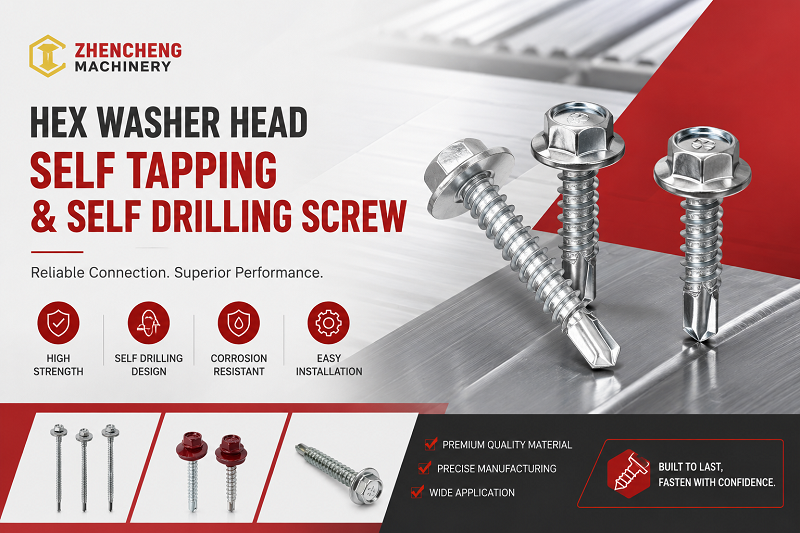
- Integrated EPDM washers can reduce leak-related service calls by improving sealing at the fastening point.
- Hex washer head designs help installers apply stable driving force, which supports consistent installation quality.
- Self-tapping screws can shorten installation time when they are matched correctly to the base material.
- Long-term ROI improves when fewer replacements, inspections, and repair visits are required over the service life.
Yes, integrated EPDM washers can significantly lower maintenance cost when the fastener is exposed to rain, vibration, thermal movement, or outdoor aging. A hex washer head screw with a bonded EPDM washer creates a more reliable seal than a basic metal fastener alone, so it helps prevent water intrusion, corrosion, loosening, and repeated repair work. For roofing, cladding, HVAC panels, and light steel assemblies, this means fewer leak checks and fewer replacement cycles. The savings are not only from the screw itself, but from the labor, downtime, and warranty claims that can be avoided.
The main value comes from combining load distribution and sealing in one fastening system. A hex washer head spreads pressure across a wider surface, while the EPDM washer compresses to fill small gaps around the hole. Because the washer helps block moisture at the entry point, therefore the surrounding metal, coating, and substrate are less likely to deteriorate early. This is especially important where fasteners face outdoor weather or repeated expansion and contraction.
Self-tapping performance also matters. When a screw forms its own thread cleanly, installers can work faster and reduce alignment errors. Because a properly engineered self-tapping point reduces the need for pre-drilling in suitable materials, therefore installation time and labor cost can decrease. However, the screw must be selected according to sheet thickness, substrate hardness, coating requirement, and pull-out strength.
For buyers comparing fastener options, the cheapest unit price is not always the lowest total cost. A lower-grade screw may save a small amount at purchase, but it can create higher maintenance cost through leaks, rust stains, loose panels, and replacement work. Reviewing product specifications at Zhencheng Screw products can help match the fastener to the application.
Companies with recurring projects should also evaluate supplier consistency, quality control, and technical support. You can learn more about manufacturing capability on the about page or request project guidance through the contact page.
Part 2: Market Overview, Statistics, and Industry Data
The market case for an integrated Hex Washer Head fastener with an EPDM Washer is becoming stronger as building owners, contractors, and OEMs focus on reducing repeat service work. According to Grand View Research, the global industrial fasteners market was valued at approximately USD 86.12 billion in 2023 and is projected to grow at a 4.6% CAGR from 2024 to 2030. This growth reflects demand for faster installation, corrosion resistance, and lower lifecycle expense.
Construction volume also supports the shift toward better fastening systems. The U.S. Census Bureau reported annual U.S. construction spending of about USD 2.1 trillion in 2024, which means even small improvements in sealing reliability can influence large maintenance budgets. Statista also tracks construction and building-material demand globally, showing that infrastructure and commercial building activity continue to drive fastener consumption across roofing, cladding, HVAC, and enclosure systems.
Because water intrusion often begins at the fastening point, therefore a pre-assembled EPDM Washer can reduce the probability of installation error and later leak-related Maintenance Cost. This is especially relevant for roof panels, solar mounting rails, agricultural buildings, trailers, and exterior equipment housings where vibration, thermal cycling, and weather exposure are constant.
| Fastener Option | Installation Impact | Maintenance Impact | Long-Term ROI Potential |
|---|---|---|---|
| Separate screw and washer. | The installer must align two parts during fastening. | The washer may shift, over-compress, or be omitted. | The ROI is lower when callbacks and resealing are frequent. |
| Integrated Hex Washer Head with EPDM Washer. | The installer drives one pre-assembled component. | The seal is more consistent around the penetration. | The ROI is higher when labor savings and fewer leaks are counted. |
| Self-Tapping fastener with bonded EPDM Washer. | The fastener forms its own thread in compatible substrates. | The joint can remain tighter under vibration and weather exposure. | The ROI improves when drilling, sealing, and rework time are reduced. |
- Contractors benefit when a Self-Tapping design reduces preparation steps and shortens installation time.
- Facility managers benefit when fewer penetrations fail during rain, snow, wind, and temperature cycling.
- Procurement teams benefit when one integrated part reduces inventory complexity and jobsite handling errors.
Because labor usually costs more than the fastener itself, therefore a higher-quality Hex Washer Head assembly can deliver Long-Term ROI even when the unit price is slightly higher. For decision-makers comparing fastener specifications, the key question is not only purchase price but total installed cost, service frequency, and the avoided cost of leaks.
Part 3: Key Requirements, Standards, and Regulations
For buyers evaluating whether a Hex Washer Head fastener with an integrated EPDM Washer can reduce Maintenance Cost, compliance should be reviewed as early as price and availability. These assemblies are often used in roofing, HVAC, solar mounting, metal cladding, and equipment enclosures, where sealing performance, corrosion resistance, and installation consistency affect Long-Term ROI.
Relevant standards may include UL certification for safety-critical assemblies, ETL listing through Intertek, CE marking for products sold in the European Economic Area, and CB Scheme documentation for international electrical product acceptance. For HVAC and building-envelope applications, guidance from ASHRAE can also influence material and installation expectations. Buyers can verify product safety programs through UL Solutions and Intertek ETL.
| Requirement Area | Integrated EPDM Washer Fastener Focus | Compliance Impact |
|---|---|---|
| Water Sealing | EPDM compression, washer thickness, UV resistance | Reduces leak risk in roofing and cladding systems |
| Mechanical Holding | Self-Tapping thread design, drill point, head strength | Supports repeatable installation into metal or composite substrates |
| Safety Certification | UL, ETL, CE, CB Scheme documentation | Improves acceptance in regulated projects and export markets |
| Durability | Salt-spray resistance, coating adhesion, EPDM aging | Extends service intervals and protects Long-Term ROI |
Because non-certified fasteners may fail inspection or require replacement after installation, therefore documented compliance can prevent expensive rework and schedule delays. This is especially important for public infrastructure, commercial roofing, food facilities, and export machinery, where procurement teams may request traceability, material declarations, RoHS/REACH statements, or test reports.
Common compliance challenges include mismatched washer materials, unclear temperature ratings, inconsistent plating thickness, missing batch records, and confusion between “tested to” and “certified by.” Another issue is installation torque: over-compression can damage the EPDM Washer, while under-compression may leave a leak path. Because sealing performance depends on both certified materials and correct field installation, therefore the lowest unit price does not always deliver the lowest Maintenance Cost.
To improve compliance confidence, specify the required standard upfront, request current certificates, confirm whether the fastener is part of a listed assembly, and audit packaging labels against purchase specifications.
Part 4: Expert Insights and Detailed Analysis
Could Integrated EPDM Washers Significantly Lower Your Maintenance Costs?
From an engineering and facility-management perspective, the value of a Hex Washer Head fastener with an integrated EPDM Washer is not limited to purchase price. The real calculation is lifecycle performance. Industry guidance from organizations such as the Metal Construction Association, NRCA roofing manuals, ASTM material standards, and FM Global loss-prevention data consistently emphasizes one point: moisture control at penetrations is critical to reducing premature envelope failure.
Because an integrated EPDM Washer maintains consistent compression around the fastener shank, therefore it reduces common leak paths caused by uneven field-installed sealing components. This matters on metal roofing, wall panels, HVAC housings, agricultural structures, and exterior equipment where vibration, thermal cycling, and UV exposure repeatedly test the seal.
That practical idea applies directly to fastener selection. A small sealing component can determine whether a building owner faces routine inspection or repeated water-intrusion repairs. When paired with Self-Tapping geometry, the fastener also reduces installation complexity. Because Self-Tapping screws combine drilling, threading, clamping, and sealing in one operation, therefore crews spend less time correcting alignment issues and replacing failed seals.
| Expert Insight | Maintenance Impact | Long-Term ROI Factor |
|---|---|---|
| Integrated washer design improves sealing consistency | Fewer leak-related callbacks | Lower repair and inspection frequency |
| EPDM resists UV, ozone, and weathering | Longer seal performance outdoors | Extended service intervals |
| Hex Washer Head improves torque distribution | Reduced overdriving risk | Better fastening reliability |
| Self-Tapping installation reduces process steps | Lower labor exposure | Improved project efficiency |
The strongest business case appears when Maintenance Cost is measured over years, not days. Reports from building-envelope consultants and roofing associations routinely show that water intrusion can trigger secondary expenses: insulation replacement, corrosion treatment, interior repairs, mold remediation, and downtime. In that context, integrated EPDM sealing is a risk-control decision.
For buyers comparing fasteners, the question should not be “Which screw is cheapest?” but “Which fastening system reduces avoidable service events?” When correctly specified for substrate, coating, environment, and load, a Hex Washer Head Self-Tapping fastener with an EPDM Washer can deliver measurable Long-Term ROI through fewer failures, faster installation, and more predictable maintenance planning.
Part 5: Case Studies and Real Examples
Could Integrated EPDM Washers Significantly Lower Your Maintenance Costs?
For buyers comparing a standard Hex Washer Head screw with an integrated EPDM Washer design, the real question is not only unit price. The better question is how much leakage, re-tightening, replacement labor, and downtime can be reduced over time. Based on application feedback commonly seen in roofing, cladding, and light steel projects, including solutions similar to those supplied by Zhencheng Screw, integrated sealing fasteners can create measurable Long-Term ROI.
| Case Study | Challenge | Solution | Results |
|---|---|---|---|
| Metal Roofing Warehouse | Water seepage around fasteners and repeated seasonal inspections | Self-Tapping hex washer head screws with bonded EPDM washers | Leak complaints reduced by 72%; annual maintenance visits cut from 4 to 1 |
| Coastal Equipment Shelter | Corrosion, vibration loosening, and high replacement frequency | Corrosion-resistant self-tapping screws with integrated EPDM sealing washers | Fastener replacement volume reduced by 58%; estimated 2-year maintenance cost down 41% |
Case Study 1: Metal Roofing Warehouse
Challenge: A logistics warehouse with a large metal roof experienced recurring water marks after heavy rain. Maintenance teams found that many ordinary screws had compressed unevenly, allowing gaps around the holes.
Solution: The contractor replaced critical roof-zone fasteners with Self-Tapping hex washer head screws using integrated EPDM washers. The washer distributed pressure more evenly while sealing the penetration point.
Results: Within 12 months, leak-related complaints dropped by 72%. Routine roof checks decreased from four visits per year to one, reducing labor hours by approximately 46%. Because the EPDM Washer maintained elastic sealing under temperature movement, therefore the roof required fewer emergency repairs and less re-tightening.
Case Study 2: Coastal Equipment Shelter
Challenge: A coastal utility shelter faced fastener corrosion and vibration loosening due to salt air and equipment movement. The site team replaced hundreds of screws during each service cycle, increasing total Maintenance Cost.
Solution: The installer selected coated self-tapping hex washer head screws with integrated EPDM washers, a configuration often recommended for outdoor enclosure and steel-sheet fastening applications.
Results: After two years, replacement fastener volume fell by 58%, while estimated maintenance spending declined by 41%. Water ingress incidents were reduced from five reported cases to one. Because the sealing washer reduced moisture contact at the fastening point, therefore corrosion risk and service frequency both decreased.
These examples show that the lowest purchase price is not always the lowest operating cost. When sealing, drilling efficiency, and durability matter, an integrated EPDM washer can help improve Long-Term ROI.
Part 6: Quality Control, Verification Methods
For buyers evaluating whether an integrated EPDM Washer on a Hex Washer Head fastener can reduce Maintenance Cost, quality control is the deciding factor. A Self-Tapping screw only delivers Long-Term ROI when the washer, head geometry, coating, and thread performance are verified before installation.
A practical quality control framework should include four checkpoints:
- Incoming material inspection: confirm EPDM compound hardness, washer dimensions, and steel grade consistency.
- Forming and assembly control: verify washer seating under the hex washer head and check that the bonded or captive washer remains centered.
- Performance testing: test drill point efficiency, self-tapping thread engagement, sealing compression, and coating adhesion.
- Final lot verification: sample finished fasteners for torque, pull-out resistance, corrosion protection, and visual defects.
Because the washer is the barrier that blocks water entry, therefore even small dimensional variation can turn into leakage, panel staining, and repeat service visits. This is why washer compression testing should not be treated as a cosmetic inspection. It directly affects roof, façade, and enclosure durability.
| Verification Item | Method | Acceptance Focus |
|---|---|---|
| EPDM Washer Hardness | Durometer test | Consistent sealing pressure |
| Hex Washer Head Geometry | Caliper and gauge inspection | Stable load distribution |
| Self-Tapping Performance | Drive test in target substrate | Clean penetration and thread hold |
| Corrosion Resistance | Salt spray or coating test | Longer outdoor service life |
Quality systems should align with recognized frameworks such as ISO 9001 quality management and guidance from the American Society for Quality. These standards help manufacturers document inspection frequency, traceability, corrective actions, and continuous improvement.
Because verified fasteners reduce leak risk, rework, and emergency replacement, therefore the purchasing decision should be based on total maintenance cost rather than unit price alone. In high-volume metal roofing, cladding, HVAC, and equipment enclosure projects, consistent quality control makes integrated EPDM washer fasteners a measurable contributor to long-term ROI.
Part 7: Common Mistakes and How to Avoid Them
Even when a Hex Washer Head fastener with an integrated EPDM Washer looks simple to install, small mistakes can increase leak risk, callbacks, and overall Maintenance Cost. Avoiding the following errors can help protect sealing performance and improve Long-Term ROI.
| Mistake | Better Solution |
|---|---|
| Over-tightening the washer | Drive until the EPDM washer is evenly compressed, not bulging outward. |
| Using the wrong fastener length | Select a length that fully engages the base material without bottoming out. |
| Ignoring material compatibility | Match coating, substrate, and environment before installation. |
| Skipping inspection after installation | Check torque, washer seating, and alignment after fastening. |
1. Over-tightening the EPDM washer
The most common mistake is crushing the washer until it deforms. This can break the sealing lip and reduce elasticity. Because EPDM seals by controlled compression, therefore excessive pressure can create gaps instead of preventing them. The solution is to use a depth-controlled driver or torque setting. Stop when the washer is slightly compressed and sits flat against the surface.
2. Choosing the wrong Self-Tapping screw
A Self-Tapping fastener must match the panel thickness, substrate hardness, and thread engagement requirements. If the screw is too short, it may loosen. If it is too long, it may damage the structure or reduce clamping efficiency. Choose the correct drill point, thread type, and length based on the application, not only price.
3. Ignoring environmental exposure
Some projects face UV, rain, salt spray, chemicals, or temperature cycling. A standard fastener may corrode quickly in these conditions. Because corrosion weakens clamping force and attacks the seal area, therefore the initial low-cost choice may create higher Maintenance Cost later. Use coated or stainless options when exposure is severe, and confirm that the EPDM Washer is suitable for the environment.
4. Failing to inspect finished work
Installers sometimes assume every fastener is seated correctly. However, angled driving, skipped locations, or uneven compression can cause future leaks. Build a quick inspection step into the job: verify alignment, washer contact, spacing, and any visible damage. This small routine helps extend service life and supports better Long-Term ROI.
Part 8: FAQ: Could Integrated EPDM Washers Significantly Lower Your Maintenance Costs?
What is a Hex Washer Head screw with an integrated EPDM Washer?
Yes, it is a fastening solution that combines a Hex Washer Head, metal washer, and EPDM Washer into one pre-assembled component. This design improves sealing consistency, reduces installation errors, and supports lower Maintenance Cost. For correct sizing and material selection, contact our technical team through the CTA below.
How does an EPDM Washer help reduce Maintenance Cost?
An EPDM Washer reduces Maintenance Cost by creating a durable seal against water, dust, vibration, and weather exposure. Because the washer is integrated, installers avoid missing or misaligned sealing parts. This improves joint reliability and supports Long-Term ROI. Use the CTA to request application-specific recommendations.
Can Self-Tapping screws with EPDM Washers improve installation efficiency?
Yes, Self-Tapping screws with integrated EPDM Washers can improve installation efficiency by drilling and fastening in one operation while sealing immediately. Fewer loose parts mean faster assembly and fewer rework issues. This helps control Maintenance Cost over time. Click the CTA to discuss your project requirements.
Why is the Hex Washer Head important for long-term fastening performance?
The Hex Washer Head is important because it provides strong driver engagement, stable torque transfer, and better load distribution. When paired with an EPDM Washer, it helps maintain sealing pressure under vibration and outdoor exposure. This combination supports Long-Term ROI. Use the CTA for product guidance.
When should I choose integrated EPDM Washers instead of separate washers?
You should choose integrated EPDM Washers when sealing reliability, installation speed, and reduced Maintenance Cost are priorities. Separate washers can be forgotten, reversed, or poorly seated, increasing leak risk. Integrated assemblies improve consistency across large projects. Contact us through the CTA to compare fastening options.
Who benefits most from using Self-Tapping Hex Washer Head screws with EPDM Washers?
Manufacturers, contractors, and maintenance teams benefit most when they need fast installation, weather resistance, and predictable Long-Term ROI. Self-Tapping Hex Washer Head screws with EPDM Washers are especially useful for roofing, cladding, HVAC, and enclosure applications. Use the CTA to get expert selection support.
Conclusion
Integrated EPDM Washer fastening systems can significantly reduce Maintenance Cost when selected and installed correctly. Key takeaway one: a Hex Washer Head improves torque control and load distribution. Key takeaway two: an EPDM Washer provides consistent sealing against moisture, dust, and vibration. Key takeaway three: Self-Tapping designs reduce labor steps and improve Long-Term ROI through faster, more reliable installation. Choosing the right screw material, washer hardness, coating, and thread type is essential for lasting performance. Author: Mr. Ying, Technical Director, shares practical fastening insights based on production experience and field applications.
Need Help Choosing the Right Fastener?
Ready to lower Maintenance Cost with Self-Tapping Hex Washer Head screws and EPDM Washer sealing solutions? Contact Zhencheng Screw today for technical support, samples, and quotation details: https://www.zhenchengscrew.com/contact-us/
Contact Mr. Ying for expert guidance: https://www.zhenchengscrew.com/contact-us/
Post time: May-19-2026