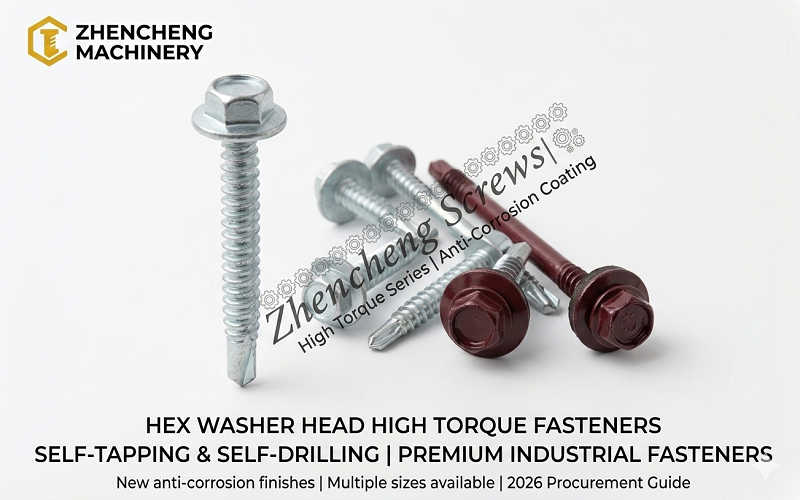
- High-Torque Hex Washer Head screws reduce installation delays by improving driving stability and torque transfer.
- Self-Drilling screw designs can remove separate drilling steps and support faster assembly flow.
- Consistent fastening performance helps operators reduce rework, tool slips, and production interruptions.
- Better screw selection supports Industrial Efficiency across metal fabrication, roofing, machinery, and enclosure assembly.
High-Torque Hex Washer Head screws improve production cycle time by helping operators fasten materials faster, with fewer tool slips, fewer pilot-hole operations, and more consistent clamp force. Their integrated washer head spreads load while the hex drive transfers torque efficiently, so crews can complete each fastening point with less hesitation and less rework. When the screw is also Self-Drilling, it can cut into metal and form the fastening point in the same operation. Because the fastening process combines drilling, seating, and tightening into a smoother motion, therefore each assembly station can reduce wasted handling and improve throughput.
In production environments, small delays at each fastening point can accumulate into meaningful losses across a shift. A stable Hex Washer Head design helps the bit stay engaged during high-speed driving, which is especially important when workers install fasteners into steel sheets, aluminum profiles, brackets, or equipment panels. The washer-style bearing surface also helps distribute pressure, which can reduce surface damage and improve joint reliability.
For manufacturers focused on Industrial Efficiency, the value is not only speed. It is repeatability. Because High-Torque screws are designed to accept stronger driving force without easy cam-out, therefore operators can maintain a steadier rhythm and quality teams can see fewer defects linked to loose or misaligned fasteners. This supports smoother downstream assembly, packaging, and inspection.
Companies comparing fastener options can review product categories at Zhencheng Screw products to match screw geometry, coating, point style, and head design to the application. Buyers who want to understand production capability can visit the about page. For custom specifications, drawings, or bulk purchasing discussions, teams can use the contact page.
In the next stage of fastener selection, engineers should evaluate substrate thickness, corrosion exposure, drive tooling, and required clamp performance before finalizing a High-Torque Hex Washer Head Self-Drilling screw.
Part 2: Market Overview, Statistics, and Industry Data
The demand for Hex Washer Head fasteners is rising as manufacturers focus on measurable gains in Industrial Efficiency, assembly consistency, and shorter Cycle Time. According to Grand View Research, the global industrial fasteners market was valued at about USD 86.12 billion in 2023 and is projected to grow at a 4.1% CAGR from 2024 to 2030. This growth reflects broader investment in automated assembly, metal fabrication, HVAC, roofing, transportation, and equipment manufacturing.
Fastener selection directly affects production speed. A Self-Drilling screw can eliminate a separate pilot-hole operation, while a High-Torque design improves drive stability under demanding installation loads. Because fewer tool changes and fewer pre-drilling steps reduce handling time, therefore high-torque hex washer screws can support faster line throughput and lower labor minutes per assembly.
Labor pressure also supports this shift. The U.S. Bureau of Labor Statistics reported that production occupations represented millions of U.S. jobs, making even small time savings per fastening point financially meaningful at scale. In parallel, Statista tracks global automotive production in the tens of millions of vehicles annually, showing how high-volume manufacturing magnifies the value of every second saved.
| Fastening Method | Typical Production Impact | Efficiency Advantage |
|---|---|---|
| Standard screw with pilot hole | The operator must drill first and then change or reposition tools. | This method can increase handling time and introduce alignment variation. |
| Self-drilling hex washer screw | The screw drills and fastens in one operation. | This method can reduce steps and improve repeatability in sheet metal assemblies. |
| High-torque Hex Washer Head screw | The drive interface supports stronger torque transfer during installation. | This method can reduce cam-out, rework, and inconsistent seating. |
Industry guidance from NIST emphasizes the value of process control and measurement in manufacturing performance. Because fastening defects create rework, downtime, and inspection delays, therefore a more stable high-torque fastening system helps protect Cycle Time and overall Industrial Efficiency. For manufacturers using thin steel, aluminum panels, or coated sheet metal, the market trend is clear: the right Self-Drilling Hex Washer Head screw is no longer a small component choice; it is a production-cycle decision.
Part 3: Key Requirements, Standards, and Regulations
When specifying a Hex Washer Head fastener for High-Torque, Self-Drilling applications, compliance is not just a paperwork issue; it directly affects assembly reliability, warranty exposure, and total Cycle Time. In production environments such as HVAC, electrical enclosures, metal buildings, and appliance manufacturing, screws may need to support safety, grounding, corrosion resistance, and vibration-performance requirements.
Key certification frameworks often referenced include UL, ETL by Intertek, CE marking, and the CB Scheme. For HVAC-related assemblies, engineers may also review guidance from ASHRAE, especially where fasteners are used in ductwork, rooftop units, or thermal-system housings.
| Requirement Area | Standard / Mark | Production Impact |
|---|---|---|
| Electrical safety and component recognition | UL, ETL | Helps confirm fasteners are suitable for listed assemblies and reduces rework during audits. |
| International market access | CE, CB Scheme | Supports export documentation and simplifies cross-border product approvals. |
| Mechanical performance | Torque, pull-out, drill-point, and clamp-load testing | Improves Industrial Efficiency by reducing stripped heads, broken points, and loose joints. |
| Environmental durability | Salt spray, coating thickness, corrosion testing | Extends service life in outdoor, HVAC, and high-humidity applications. |
Common compliance challenges include mismatched material certificates, unclear coating specifications, non-traceable lots, and using one screw type across too many substrates. Because a High-Torque screw transfers more driving force into the joint, therefore the washer geometry, thread form, and coating must be validated together rather than separately.
Another frequent issue is assuming that a certified final product automatically qualifies every replacement fastener. Because UL, ETL, CE, and CB evaluations may depend on the exact component configuration, therefore changing a Hex Washer Head screw can trigger additional documentation or retesting. To protect Cycle Time, purchasing teams should request test reports, RoHS/REACH statements where applicable, coating data, and lot traceability before mass production begins.
Part 4: Expert Insights, Detailed Analysis
How Can High-Torque Hex Washer Screws Improve Your Production Cycle Time?
From an industrial engineering perspective, the value of a Hex Washer Head screw is not only in holding strength; it is in process compression. A High-Torque, Self-Drilling fastener combines drilling, tapping, and fastening into one controlled motion, reducing tool changes and operator handling. Because fewer separate operations are required, therefore each station can complete more assemblies per shift with less variability.
Reports from the Manufacturing Institute, NIST Manufacturing Extension Partnership, and OSHA guidance on ergonomic risk reduction consistently emphasize that productivity gains often come from eliminating non-value-added motion, rework, and inconsistent manual force. In this context, high-torque hex washer screws improve Industrial Efficiency by delivering better torque transfer, wider bearing surface, and more stable seating pressure than many standard fasteners.
| Expert Insight | Production Impact | Cycle Time Benefit |
|---|---|---|
| Integrated self-drilling point | Removes pre-drilling in many metal-to-metal applications | Shortens each fastening sequence |
| Hex washer head geometry | Improves tool engagement and load distribution | Reduces cam-out, slippage, and correction time |
| High-torque capability | Supports consistent clamping in demanding assemblies | Lowers rework and inspection failures |
In practice, the biggest gains appear in repetitive assembly environments: HVAC panels, steel framing, equipment housings, roofing systems, and light-gauge fabrication. Because operators can maintain a faster rhythm without switching bits or repositioning parts, therefore total Cycle Time improves across the full production cell, not just at the screw-driving step.
Authoritative lean manufacturing references, including NIST MEP resources, stress that small time savings repeated thousands of times become measurable throughput improvements. Even a few seconds saved per fastener can affect labor cost, takt time, and on-time delivery.
For production managers, the key is application testing. Match screw diameter, drill point, coating, drive tooling, RPM, and substrate thickness. When specified correctly, high-torque hex washer self-drilling screws become a practical lever for faster assembly, stronger joints, and higher industrial efficiency.
How Can High-Torque Hex Washer Screws Improve Your Production Cycle Time?
In high-volume assembly, small fastening delays can multiply into hours of lost output. A Hex Washer Head screw designed for High-Torque driving and Self-Drilling installation can reduce tool changes, pilot-hole operations, and rework. Based on application patterns seen in industrial fastening projects, including screw categories supplied by manufacturers such as Zhencheng Screw, the following two case studies show how the right fastener improves Cycle Time and overall Industrial Efficiency.
Case Study 1: Steel HVAC Cabinet Assembly
Challenge: A manufacturer of steel HVAC cabinets used separate drilling and fastening steps for 0.8–1.2 mm galvanized sheet panels. Operators frequently stopped to replace worn bits, and screw head slippage caused cosmetic damage.
Solution: The plant switched to high-torque hex washer head self-drilling screws with a bonded washer. The hex drive improved torque transfer, while the drilling point eliminated the pilot-hole stage.
Results: Average fastening time dropped from 9.5 seconds to 6.8 seconds per screw, a 28% improvement. Rework caused by stripped heads fell by 41%, and daily cabinet output increased from 420 to 510 units. Because the Self-Drilling point removed one preparation step, therefore operators completed each joint faster with fewer interruptions.
Case Study 2: Solar Mounting Rail Production
Challenge: A solar racking producer needed faster assembly of aluminum rails and steel brackets. Standard pan head screws could not consistently handle the torque required, leading to cam-out and inconsistent clamp pressure.
Solution: The production team adopted high-torque hex washer screws with corrosion-resistant coating. The integrated washer distributed load more evenly, and the hex washer head allowed stable driving at higher speed.
Results: Cycle time per rail assembly decreased from 14 minutes to 11.2 minutes. Torque-related failures dropped from 3.6% to 0.9%, and monthly output increased by 18%. Because the Hex Washer Head provided better tool engagement under High-Torque loading, therefore the line achieved more consistent fastening without slowing the driver speed.
| Case Study | Challenge | Solution | Measured Result |
|---|---|---|---|
| HVAC Cabinet Assembly | Separate drilling, bit wear, head slippage | High-torque self-drilling hex washer screws | 28% faster fastening; 41% less rework |
| Solar Mounting Rails | Cam-out and inconsistent clamp force | Coated hex washer head screws for high torque | 20% shorter assembly time; 18% higher output |
These examples show that the correct fastener is not only a component choice; it is a production strategy. For factories aiming to reduce Cycle Time, self-drilling high-torque hex washer screws can deliver measurable gains in speed, quality, and Industrial Efficiency.
Part 6: Quality Control and Verification Methods
To ensure a Hex Washer Head, High-Torque, Self-Drilling screw truly improves Cycle Time and Industrial Efficiency, quality control must be built into every stage of production and assembly. A faster fastener only creates value when it performs consistently under real manufacturing conditions.
Quality Control Checkpoint Framework
- 1. Incoming Material Inspection: Verify steel grade, coating thickness, hardness, and washer integrity before screws enter production or assembly inventory.
- 2. Dimensional Verification: Check head height, washer diameter, drill point geometry, thread pitch, and shank length against engineering drawings.
- 3. Torque and Drive Testing: Confirm that the Hex Washer Head can withstand specified installation torque without stripping, rounding, or head separation.
- 4. Self-Drilling Performance Test: Measure drill-through time, hole quality, and thread engagement in the target substrate.
- 5. Final Batch Audit: Review packaging, traceability codes, sampling records, and compliance documentation before release.
Because high-torque fastening depends on stable head geometry and consistent material hardness, therefore dimensional and mechanical checks must be completed before screws reach the production line. This prevents tool slippage, rework, and unexpected stoppages that reduce cycle time gains.
| Verification Item | Test Method | Acceptance Criteria | Production Impact |
|---|---|---|---|
| Hex Washer Head Fit | Go/no-go gauge and visual inspection | Full socket engagement, no deformation | Reduces cam-out and tool change delays |
| Torque Resistance | Calibrated torque wrench test | Meets specified high-torque range | Improves fastening consistency |
| Self-Drilling Speed | Timed drill-through test | Consistent penetration within limit | Supports shorter cycle time |
| Coating Quality | Thickness and corrosion testing | Meets project specification | Reduces field failures |
Manufacturers should align inspection plans with ISO 9001 quality management principles and sampling guidance commonly promoted by ASQ quality resources. These standards help define repeatable processes, corrective actions, and supplier performance metrics.
Because verified Self-Drilling screws reduce installation variation, therefore operators spend less time correcting misdrilled holes, replacing damaged fasteners, or adjusting torque tools. The result is a more predictable assembly process, stronger quality assurance, and measurable Industrial Efficiency across high-volume production environments.
Part 7: Common Mistakes and How to Avoid Them
Even when using a Hex Washer Head, High-Torque, Self-Drilling screw, small setup mistakes can reduce Cycle Time gains and weaken Industrial Efficiency. Below are common production errors and practical ways to avoid them.
| Mistake | Impact on Production | Better Solution |
|---|---|---|
| Using the wrong screw length | Poor clamping or material damage | Match screw length to stack thickness and application load |
| Applying excessive torque | Stripped threads, washer deformation, slower rework | Use calibrated drivers and approved torque settings |
| Ignoring material compatibility | Drilling failure, corrosion, premature loosening | Select coating, point style, and hardness for the base material |
1. Choosing the Wrong Screw Length
A common mistake is selecting a screw that is too short or too long for the assembly. If it is too short, the screw may not form enough thread engagement. If it is too long, it can pierce unwanted areas or slow installation. Because proper thread engagement controls holding power, therefore the screw length should be verified against total material thickness before production starts. Use a sample joint test and document the approved size for operators.
2. Over-Tightening High-Torque Screws
High-torque capability does not mean unlimited torque. Excess force can strip threads, crush panels, or damage the washer head. This creates rework and increases cycle time instead of reducing it. The solution is to set torque-controlled tools for each application and inspect the first pieces at shift start. Because consistent torque prevents fastening variation, therefore calibrated tools improve repeatability and industrial efficiency.
3. Using the Wrong Self-Drilling Point
Not all self-drilling screws work equally across metal thicknesses. A point that is too small may burn out, while an oversized point may create poor thread formation. Choose the drill point based on material gauge, hardness, and production speed. Run pilot tests before full-scale use to confirm drilling time, chip removal, and final clamp strength.
4. Skipping Operator Training
Even the best Hex Washer Head screw can fail if operators use the wrong angle, speed, or pressure. Misalignment causes wobbling, damaged heads, and inconsistent fastening. Provide short visual work instructions, driver setup guides, and periodic training. When operators understand the correct fastening method, high-torque self-drilling screws can deliver faster installation, fewer defects, and a smoother production cycle.
Part 8: FAQ — How Can High-Torque Hex Washer Screws Improve Your Production Cycle Time?
What is a Hex Washer Head screw, and why does it matter for production speed?
A Hex Washer Head screw combines a hex drive with an integrated washer surface, giving operators stronger grip, better load distribution, and faster seating. In high-volume assembly, this reduces tool slip and rework, supporting better Cycle Time. For application-specific sizing, contact our team for guidance.
How do High-Torque screws reduce Cycle Time in industrial assembly?
High-Torque screws reduce Cycle Time by allowing faster driving speeds without frequent stripping, cam-out, or incomplete fastening. Their stronger drive engagement supports consistent installation across shifts and operators. This improves Industrial Efficiency by minimizing stoppages. Contact our team to compare torque requirements for your production line.
Why are Self-Drilling Hex Washer Head screws useful for metal fastening?
Self-Drilling Hex Washer Head screws drill and fasten in one operation, eliminating separate pilot-hole steps. This shortens handling time, reduces tooling changes, and improves fastening consistency in sheet metal or structural applications. For the correct drill point, coating, and length, contact our team for technical recommendations.
When should manufacturers choose High-Torque fasteners over standard screws?
Manufacturers should choose High-Torque fasteners when assemblies require stronger clamping force, faster installation, or reliable performance under vibration and repeated loading. Compared with standard screws, they help reduce defects and downtime. If your line struggles with stripped heads or slow fastening, contact our team for a review.
How can Hex Washer Head screws improve Industrial Efficiency beyond fastening?
Hex Washer Head screws improve Industrial Efficiency by standardizing installation, lowering operator fatigue, and reducing inspection failures. Their wide bearing surface helps maintain alignment and pressure, which supports better finished quality. To evaluate savings in labor, tooling, and Cycle Time, contact our team for application support.
What specifications should buyers check before ordering Self-Drilling High-Torque screws?
Buyers should confirm material grade, thread type, drill point, head dimensions, coating, torque capacity, and substrate thickness before ordering. Matching these details prevents installation delays and premature failures. For stable Cycle Time and dependable Industrial Efficiency, contact our team to verify specifications before bulk purchasing.
Conclusion
High-Torque Hex Washer Head screws can improve production by accelerating fastening, reducing slippage, and lowering rework. The three key takeaways are clear: first, Self-Drilling designs remove extra preparation steps; second, stronger torque transfer supports stable Cycle Time; third, consistent clamping improves Industrial Efficiency across demanding assembly environments. Choosing the right screw specification is not only a purchasing decision, but a process improvement strategy. This article is written by Mr. Ying, Technical Director, who focuses on practical fastening solutions for manufacturers seeking stronger performance, repeatable installation, and measurable production gains.
Improve Your Fastening Process Today
Need the right Hex Washer Head, High-Torque, or Self-Drilling screw for faster Cycle Time? Contact Zhencheng Screw today for technical support, specification matching, and production-focused recommendations: https://www.zhenchengscrew.com/contact-us/ .
Contact Mr. Ying for expert guidance: https://www.zhenchengscrew.com/contact-us/
Post time: May-12-2026