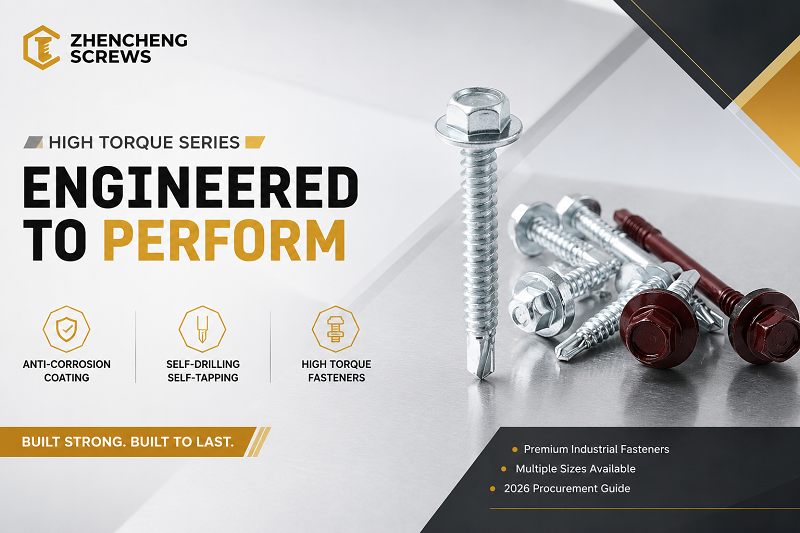
- You should re-evaluate pull-out resistance when metal siding shows movement, corrosion, vibration damage, or fastener loosening.
- Hex washer head self-drilling screws must match the siding thickness, substrate strength, and environmental exposure.
- A safety evaluation helps prevent panel detachment, water intrusion, and long-term structural risk.
- Working with a reliable screw manufacturer can improve fastening consistency and installation confidence.
Yes, it may be time to re-evaluate the pull-out resistance of your metal siding screws if your building has experienced high wind, repeated vibration, temperature cycling, corrosion, or visible fastener loosening. Pull-out resistance is not a fixed value forever; it changes as the substrate ages, coatings wear, and installation conditions vary. For hex washer head self-drilling screws, this safety evaluation is especially important because the screw must hold the panel tightly while resisting uplift and movement. If the fastener no longer grips the base material properly, the entire metal siding system can become vulnerable.
Metal siding is often selected for durability, but its performance depends heavily on the fasteners behind it. A hex washer head screw provides strong bearing surface and easier driving, while a self-drilling point reduces the need for pre-drilling. However, correct installation still matters. Because an over-driven screw can damage the washer and weaken the hole, therefore the sealing and pull-out resistance may decline over time.
Common warning signs should not be ignored during routine inspection. They may indicate that a formal safety evaluation is needed.
- You should inspect the system if panels rattle during wind events or show visible movement around fastener lines.
- You should check pull-out resistance if rust stains appear near screw heads or washer edges.
- You should review fastener selection if screws spin freely during maintenance or fail to tighten securely.
- You should evaluate installation quality if leaks occur near laps, seams, or penetrations after rain.
Because metal siding transfers wind load through each fastening point, therefore even small reductions in screw grip can create larger safety risks across the wall system. This is why engineers, contractors, and facility managers should not treat screw performance as an afterthought.
For suitable fastening options, explore the product range at Zhencheng Screw products. To understand manufacturing capabilities, visit the company profile. If you need project-specific guidance, contact the team through the contact page.
Part 2: Market Overview, Statistics, and Industry Data
The demand for metal siding systems is being shaped by two parallel trends: more metal-clad commercial buildings and closer scrutiny of fastener performance. According to Grand View Research, the global metal building systems market was valued at about USD 20.4 billion in 2023, with continued growth expected as industrial, warehouse, and agricultural construction expands. At the same time, Statista reports that the global hardware market continues to generate hundreds of billions of U.S. dollars annually, indicating sustained demand for screws, anchors, and related fastening products.
For metal siding, the question is not only volume but reliability. A Hex Washer Head screw may appear minor compared with panels, framing, and insulation, yet its Pull-Out Resistance directly affects wind performance, water tightness, and service life. Because self-drilling screws create their own hole and thread path, therefore installation speed can increase while the margin for substrate mismatch, over-driving, or thread stripping must be controlled.
| Market or Safety Signal | What It Means for Metal Siding Screws |
|---|---|
| Metal building demand is growing in logistics, agriculture, and light industrial projects. | Fasteners must be selected for repeated field use, not only laboratory-rated strength. |
| Wind and storm-resilience requirements are receiving more attention from FEMA and NIST. | Pull-Out Resistance should be part of a routine Safety Evaluation for exposed wall assemblies. |
| Workplace safety guidance from OSHA emphasizes hazard prevention during construction and maintenance. | Loose or underperforming siding fasteners can become both envelope and jobsite hazards. |
- Designers should verify screw compatibility with panel thickness, purlin gauge, coating system, and expected wind exposure.
- Contractors should document torque settings and replace stripped Self-Drilling screws instead of relying on sealant alone.
- Owners should inspect high-edge zones, corners, and overhead door areas because these locations often experience higher uplift demand.
Industry references from the Metal Building Manufacturers Association, American Iron and Steel Institute, U.S. Department of Energy, U.S. Census Bureau Construction Data, and U.S. Bureau of Labor Statistics all point to a larger, more performance-driven construction environment. Because metal siding systems are increasingly used on larger and more exposed buildings, therefore the Pull-Out Resistance of Hex Washer Head fasteners should be re-evaluated before failures become visible.
Part 3: Key Requirements, Standards, and Regulations
When reviewing the Pull-Out Resistance of screws used in Metal Siding, compliance should not be treated as a paperwork exercise. A Hex Washer Head fastener may look simple, but its performance affects wind uplift resistance, panel retention, water tightness, and long-term building safety. For contractors, OEMs, and building envelope engineers, a proper Safety Evaluation should consider both mechanical test data and recognized certification frameworks.
Relevant standards and certification systems may include UL, ETL by Intertek, CE marking requirements for applicable construction products, and the CB Scheme for international electrical and product safety acceptance. In addition, energy and building performance guidance from ASHRAE may influence envelope design expectations, especially where siding assemblies contribute to thermal or moisture-control performance.
| Requirement Area | Typical Evaluation Focus | Why It Matters for Self-Drilling Screws |
|---|---|---|
| UL / ETL | Product safety, fire-related assemblies, third-party verification | Supports documented compliance for specified siding systems |
| CE / CB Scheme | International conformity and market acceptance | Helps manufacturers sell into multiple regulated regions |
| Mechanical Pull-Out Testing | Substrate thickness, screw diameter, thread design, washer compression | Confirms real fastening strength under design loads |
| Corrosion Resistance | Coating type, salt spray exposure, galvanic compatibility | Protects long-term holding power in exterior metal siding |
Common compliance challenges include inconsistent substrate thickness, mixing unverified fasteners with certified panels, insufficient documentation, and assuming that one Self-Drilling screw works for every metal gauge. Because pull-out strength depends on the screw, panel, and supporting structure as one system, therefore testing only the screw in isolation may lead to unsafe assumptions.
Another frequent issue is coating substitution. A supplier may change plating or washer material to reduce cost, but the assembly may no longer meet the original test basis. Because corrosion can reduce thread engagement and washer sealing performance over time, therefore corrosion resistance must be reviewed together with Pull-Out Resistance, not separately.
For best practice, keep test reports, installation torque ranges, approved substrate data, and certification references in the project file. This makes audits easier and helps determine whether your Hex Washer Head fasteners are still suitable for today’s Metal Siding safety expectations.
Part 4: Expert Insights and Detailed Analysis
For engineers, installers, and facility managers, the question is not simply whether a Hex Washer Head screw is “tight enough. The more important question is whether its Pull-Out Resistance still matches the real load conditions of aging Metal Siding. Industry guidance from the Metal Construction Association, the International Code Council, and ASTM fastener testing standards consistently points to one conclusion: fastener performance must be evaluated as part of the full wall assembly, not as an isolated component.
Because metal panels expand, contract, vibrate, and experience wind uplift over years of service, therefore even properly installed Self-Drilling screws can lose holding strength if substrate thickness, corrosion, or overdriving was not controlled. This is why a periodic Safety Evaluation is especially important for warehouses, agricultural buildings, coastal structures, and high-wind regions.
| Expert Focus Area | What to Check | Why It Matters |
|---|---|---|
| Washer Compression | Look for cracked, flattened, or displaced sealing washers. | Poor sealing can allow moisture intrusion and accelerate corrosion around the screw hole. |
| Substrate Engagement | Confirm the screw penetrates the correct support member and has adequate thread bite. | Insufficient engagement directly reduces Pull-Out Resistance. |
| Corrosion Evidence | Inspect rust staining, coating failure, and galvanic reaction. | Corrosion weakens both the fastener and the surrounding metal panel. |
| Installation Quality | Identify overdriven, underdriven, or misaligned Self-Drilling screws. | Incorrect torque can compromise clamping force and long-term safety. |
Authoritative reports on building-envelope failures often show that small fastening defects can become system-level risks during wind events. FEMA post-storm assessments and ICC-ES evaluation reports repeatedly emphasize verified attachment capacity, tested assemblies, and code-compliant installation.
Because pull-out failure usually begins at hidden stress points rather than visible panel damage, therefore relying only on a surface inspection can create a false sense of security. A qualified review should combine visual inspection, sample pull testing, fastener specification review, and comparison with current code requirements.
Part 5: Case Studies, Real Examples
When evaluating Hex Washer Head screws for Metal Siding, field data is more useful than catalog values alone. The following two project-style examples, based on common applications supported by suppliers such as Zhencheng Screw, show how Pull-Out Resistance testing can influence fastener selection, installation control, and long-term Safety Evaluation.
Case Study 1: Coastal Warehouse Siding Retrofit
Challenge: A coastal logistics warehouse showed loose panels after two storm seasons. The original fasteners were standard carbon steel screws installed into light-gauge steel girts. Random inspection found washer compression inconsistency and visible corrosion around several screw heads.
Solution: The contractor replaced sample areas with corrosion-resistant Self-Drilling Hex Washer Head screws using bonded EPDM washers. A torque-controlled driver was introduced, and pull-out testing was performed on existing girts before full replacement.
Results: Average pull-out resistance improved from 620 N to 1,180 N, an increase of approximately 90%. Fastener loosening complaints dropped from 14 reported points per elevation to 2 after six months. Because the original screws had reduced grip due to corrosion and inconsistent washer seating, therefore the upgraded screw coating and controlled installation directly improved holding performance.
Case Study 2: Agricultural Processing Facility Expansion
Challenge: A food-processing facility used insulated metal siding panels on a steel frame. During a pre-handover safety review, several screws failed below the project’s target pull-out value of 900 N, especially near panel overlaps.
Solution: The team switched to longer Self-Drilling Hex Washer Head screws with a more suitable drill point and thread length. Installation speed was reduced, and pilot checks were added every 500 fasteners.
Results: Retesting showed pull-out resistance increasing from an average of 780 N to 1,260 N. Panel overlap movement under simulated wind load was reduced by 38%, and rework fastener quantity fell by 52%. Because the original screw length did not provide sufficient thread engagement in the support member, therefore increasing engagement depth created a stronger and more reliable connection.
| Project | Main Issue | Fastener Change | Measured Result |
|---|---|---|---|
| Coastal Warehouse | Corrosion and loose siding | Coated Hex Washer Head screws with EPDM washers | Pull-out resistance rose from 620 N to 1,180 N |
| Processing Facility | Low pull-out values at overlaps | Longer Self-Drilling screws with better thread engagement | Average value rose from 780 N to 1,260 N |
These examples show why periodic Safety Evaluation is essential. Even a small screw specification change can significantly improve Metal Siding reliability when it is confirmed by on-site pull-out testing.
Part 6: Quality Control and Verification Methods
For any safety evaluation of Metal Siding fasteners, pull-out performance should be treated as a controlled quality characteristic, not a one-time assumption. A Hex Washer Head Self-Drilling screw may look acceptable after installation, but its actual Pull-Out Resistance depends on substrate thickness, drill point integrity, thread engagement, washer compression, and installation torque.
A practical quality control framework should include these checkpoints:
- Incoming fastener inspection: Verify material grade, coating thickness, washer condition, thread geometry, and supplier certificates before screws reach the jobsite.
- Substrate confirmation: Measure panel and structural member thickness, hardness, and corrosion condition to confirm the screw is suitable for the actual application.
- Installation process control: Check drill speed, seating pressure, torque range, and washer compression to prevent stripped holes or over-driven heads.
- Pull-out verification testing: Conduct sample field tests or lab tests using representative siding assemblies and compare results against design loads.
- Documentation and corrective action: Record failures, lot numbers, installer conditions, and retest results for traceability.
Because pull-out failure often begins with small variations in hole formation or thread engagement, therefore installation parameters must be verified during production rather than only after visible defects appear. This approach aligns with quality management principles found in ISO 9001 and continuous improvement practices promoted by the ASQ.
| Verification Item | Method | Acceptance Focus |
|---|---|---|
| Hex Washer Head condition | Visual and dimensional inspection | No deformation, correct diameter, intact washer seal |
| Self-Drilling point | Microscope or gauge check | Consistent point geometry and cutting edge |
| Pull-Out Resistance | Field pull tester or laboratory fixture | Meets design safety factor and project specification |
| Installation torque | Calibrated torque tool audit | Within approved torque window |
Because metal siding systems face wind uplift, vibration, and thermal movement, therefore fastener verification should be connected directly to risk-based safety evaluation. Certification guidance from bodies such as IAF and accredited testing organizations helps ensure that test methods, calibration, and reporting remain credible.
Re-evaluating screw performance is not just about compliance; it is about confirming that every installed fastener can perform as expected throughout the service life of the building envelope.
Part 7: Common Mistakes and How to Avoid Them
When reviewing the pull-out resistance of metal siding screws, small installation or specification errors can create major performance risks. A proper safety evaluation should look beyond the screw label and confirm whether the fastener, panel, substrate, and installation method are working together as intended.
| Mistake | Better Solution |
|---|---|
| Choosing screws by length only | Match screw diameter, thread design, drill point, and substrate thickness to the required pull-out resistance. |
| Overdriving Hex Washer Head screws | Use controlled torque settings and inspect washer compression after installation. |
| Ignoring substrate condition | Check purlins, girts, and framing for corrosion, thinning, or deformation before fastening. |
| Skipping field verification | Perform periodic pull-out testing or engineering review, especially on aging metal siding systems. |
1. Selecting Screws Based Only on Length
A common mistake is assuming a longer screw automatically provides better pull-out resistance. In reality, the thread engagement, screw diameter, point style, and base metal thickness matter just as much. For metal siding, choose a Self-Drilling screw rated for the actual steel gauge and framing material. Review manufacturer data and confirm the screw has enough thread contact without bottoming out or stripping the hole.
2. Overdriving the Fastener
Hex Washer Head screws are designed to clamp the panel while sealing the hole, but excessive torque can crush the washer, distort the siding, or strip the substrate. Because overdriving weakens the formed threads in the base metal, therefore the connection may lose pull-out resistance even if the screw looks fully seated. Use adjustable screw guns, avoid impact drivers when possible, and train installers to stop when the washer is evenly compressed.
3. Ignoring the Condition of the Supporting Metal
Even the right fastener can fail if the underlying girt or purlin is corroded, too thin, or previously damaged. Because pull-out resistance depends on the substrate holding the threads, therefore a weakened support member must be repaired, reinforced, or replaced before new screws are installed. During a safety evaluation, inspect hidden framing where leaks, rust stains, or loose panels are visible.
4. Skipping Testing After Repairs or Retrofits
Another mistake is assuming replacement screws restore the original design capacity. Field conditions vary, especially on older metal siding. After repairs, conduct sample pull-out tests or request engineering verification. This confirms that the selected Self-Drilling Hex Washer Head fasteners meet the required performance level before wind, vibration, or thermal movement exposes a weakness.
Part 8: Frequently Asked Questions
1. What is pull-out resistance in metal siding screws?
Pull-out resistance is the force required to pull a screw out of the base material. In metal siding, it depends on screw diameter, thread engagement, panel thickness, and substrate strength. For a safer safety evaluation, review your current Hex Washer Head fasteners and contact our team for technical guidance.
2. Why should I re-evaluate Hex Washer Head screws on existing metal siding?
Yes, re-evaluation is important because wind load, corrosion, vibration, and thermal movement can reduce fastening performance over time. A Hex Washer Head screw may look secure while losing pull-out resistance internally. Schedule a safety evaluation with our specialists before minor loosening becomes a structural risk.
3. When is the best time to test pull-out resistance?
The best time is before seasonal storms, after visible panel movement, or during planned maintenance. Testing is also recommended when replacing old self-drilling screws or upgrading metal siding systems. If you are unsure about timing, contact us to review your fastening condition and inspection plan.
4. How do self-drilling screws affect metal siding safety?
Self-drilling screws improve installation speed by drilling and fastening in one step, but their performance still depends on correct point design, torque control, and material compatibility. Poor installation can reduce pull-out resistance. For safer metal siding projects, ask our team to recommend suitable screw specifications.
5. Can visual inspection confirm screw pull-out resistance?
No. Visual inspection can identify rust, washer damage, loose heads, or panel deformation, but it cannot fully confirm pull-out resistance. Mechanical testing or engineering review is needed for reliable results. Combine visual checks with a professional safety evaluation, and contact us for support on fastener assessment.
6. What should I do if my metal siding screws fail a safety evaluation?
Replace or reinforce the affected fasteners immediately according to engineering recommendations. Options may include larger diameter Hex Washer Head screws, improved self-drilling designs, or substrate repair. Do not ignore failed pull-out resistance results. Contact our technical team to discuss replacement screws and project-specific solutions.
Conclusion
Re-evaluating screw performance is not just maintenance; it is risk control. Key takeaway one: pull-out resistance determines whether metal siding can remain secure under wind, vibration, and long-term movement. Key takeaway two: Hex Washer Head and self-drilling screws must match panel thickness, substrate, coating, and installation torque. Key takeaway three: a regular safety evaluation helps identify hidden fastening failure before panels loosen or leak. Author: Mr. Ying, Technical Director, focuses on fastening performance, field application analysis, and safer screw selection for metal building systems. Follow Mr. Ying on https://www.zhenchengscrew.com/ .
Need Help With Screw Safety Evaluation?
Ready to confirm your metal siding screw performance? Contact Zhencheng Screw for pull-out resistance review, Hex Washer Head selection, and self-drilling fastener support. Submit your project details here: https://www.zhenchengscrew.com/contact-us/.
Contact Mr. Ying for expert guidance: https://www.zhenchengscrew.com/contact-us/
Post time: May-15-2026