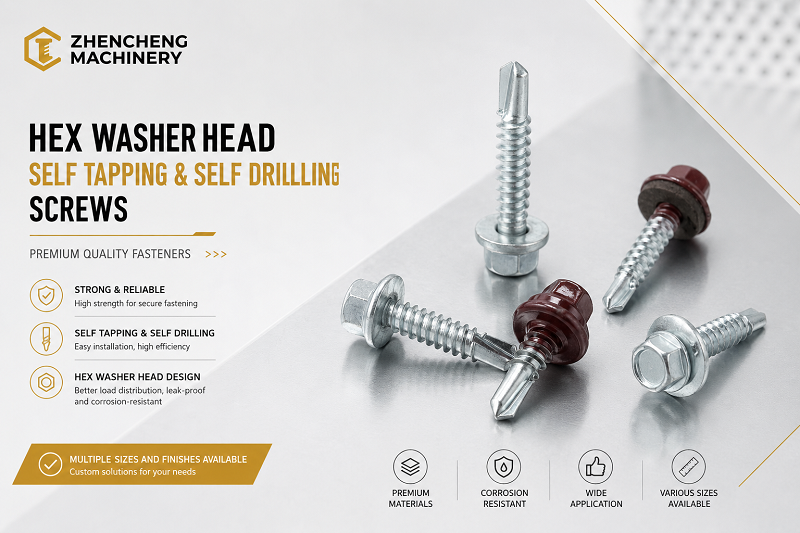
TL;DR:
- 410-grade stainless steel usually lasts longer in damp or corrosive environments because it resists rust better than plain carbon steel.
- Carbon steel can provide higher mechanical strength when properly hardened or coated for demanding fastening loads.
- For a hex washer head screw, durability depends on corrosion resistance, head strength, thread performance, and coating quality.
- The best material comparison depends on whether the application prioritizes outdoor service life or maximum clamp strength.
410-grade stainless steel generally offers better long-term durability than carbon steel for hex washer head fasteners exposed to moisture, outdoor air, or mild chemicals. Carbon steel can be stronger in direct load-bearing applications, especially when heat treated, but it is more vulnerable to rust if its coating is damaged. In simple terms, choose 410-grade stainless when corrosion resistance matters most, and choose carbon steel when high strength, lower cost, or controlled indoor use is the priority. This material comparison is not about one metal always winning; it is about matching the fastener to the environment, load, and expected service life.
A hex washer head design adds durability by spreading pressure across a wider bearing surface. This helps reduce pull-through, improves seating, and supports stable fastening in metal, wood, and composite assemblies. However, the head style cannot fully compensate for the wrong material. Because corrosion can weaken threads and reduce head integrity over time, therefore 410-grade stainless steel is often the safer choice for humid, exterior, or wash-down applications.
Carbon steel remains highly valuable because it can be manufactured with excellent hardness, tensile performance, and cost efficiency. When zinc plated, mechanically galvanized, or coated with a protective finish, carbon steel fasteners can perform well in dry construction, interior framing, and many industrial assemblies. Because carbon steel can be heat treated to achieve higher strength levels, therefore it may outperform 410-grade stainless steel in applications where mechanical load is more important than corrosion exposure.
For buyers comparing 410-grade stainless, carbon steel, durability, and material comparison factors, the practical question is where the screw will work. If the fastener will face rain, condensation, or chemical exposure, stainless performance often pays back through longer service life. If the fastener will remain indoors and carry heavier structural demand, carbon steel may be the smarter choice. To confirm the right specification, review the company background at Zhencheng Screw or discuss your application through the contact page.
Part 2: Market Overview, Statistics, and Industry Data
The Material Comparison between 410 Stainless and Carbon Steel is shaped not only by metallurgy, but also by supply scale, pricing pressure, and end-use demand. In Hex Washer Head fastening, buyers often balance corrosion resistance, head strength, drill-point performance, and total installed cost. According to Grand View Research, the global stainless steel market was valued at about USD 117.63 billion in 2023 and is projected to grow at a 6.7% CAGR from 2024 to 2030. This matters for 410 Stainless because demand from construction, energy, appliances, and transportation keeps stainless fastener supply competitive.
Carbon Steel remains dominant by volume because it is cheaper, widely available, and easy to form, heat treat, and coat. World Steel Association reported global crude steel production at approximately 1,892 million metric tons in 2023, showing the enormous production base behind Carbon Steel fasteners. Because Carbon Steel benefits from large-scale production and lower alloy content, therefore it usually offers a lower unit cost for Hex Washer Head screws in dry or coated applications.
| Market Factor | 410 Stainless Hex Washer Head | Carbon Steel Hex Washer Head | Durability Impact |
|---|---|---|---|
| Corrosion exposure | 410 Stainless offers moderate corrosion resistance with hardenability. | Carbon Steel usually needs zinc, phosphate, or other coatings. | 410 Stainless often lasts longer where moisture is present. |
| Cost pressure | 410 Stainless is usually higher in price due to chromium content. | Carbon Steel is usually more economical in bulk purchasing. | Carbon Steel may win where replacement risk is low. |
| Strength and hardness | 410 Stainless can be heat treated for strong drilling and tapping performance. | Carbon Steel can also be hardened and is common in structural fastening. | Both can be durable when matched to the correct environment. |
Industry guidance from the U.S. Geological Survey also shows how steel availability depends on iron, scrap, and alloy supply chains. Because 410 Stainless contains chromium that helps form a protective oxide layer, therefore it can provide better Durability than bare Carbon Steel in humid, mildly corrosive, or outdoor fastening conditions. However, in indoor framing, HVAC, light-gauge metal, and cost-sensitive assemblies, coated Carbon Steel remains a strong choice.
- Procurement teams should choose 410 Stainless when corrosion risk increases the lifetime cost of failure.
- Procurement teams should choose Carbon Steel when the environment is controlled and price efficiency is the main requirement.
Part 3: Key Requirements, Standards, and Regulations
When evaluating Hex Washer Head fasteners made from 410 Stainless versus Carbon Steel, compliance is not only about strength; it also concerns corrosion performance, traceability, fire safety, and suitability for the final assembly. In many HVAC, electrical, enclosure, and building-product applications, buyers may request evidence aligned with UL, ETL by Intertek, CE marking, and the CB Scheme for international electrical product acceptance.
| Compliance Factor | 410 Stainless Hex Washer Head | Carbon Steel Hex Washer Head |
|---|---|---|
| Corrosion Resistance | Moderate to good; suitable for damp or mildly corrosive environments | Depends heavily on zinc, coating, or plating system |
| Mechanical Durability | Good hardness and wear resistance after heat treatment | High strength available, especially in hardened grades |
| Certification Concerns | Material grade, passivation, and magnetic properties may need verification | Coating thickness, hydrogen embrittlement, and corrosion testing are common checks |
| Best-Fit Applications | HVAC panels, outdoor fixtures, appliance housings | Structural fastening, dry indoor assemblies, cost-sensitive projects |
Because 410 Stainless contains chromium and forms a protective oxide layer, therefore it often supports better long-term durability than uncoated Carbon Steel in humid service conditions. However, it is not equivalent to 304 or 316 stainless, so exposure to salt spray, chemicals, or coastal air should be tested before specification.
For products used in heating, ventilation, or building systems, engineers may also consider guidance from ASHRAE, especially where moisture, condensation, and temperature cycling affect fastener performance. Because Carbon Steel relies on external coatings for corrosion protection, therefore coating damage during installation can become a compliance and durability risk.
Common compliance challenges include inconsistent material certificates, unclear plating specifications, missing RoHS or REACH declarations, and confusion between component recognition and full product certification. A screw may be made from a compliant material, but the final assembly still needs evaluation under UL, ETL, CE, or CB Scheme requirements. For a reliable Material Comparison, manufacturers should document grade, hardness, coating, salt-spray performance, torque data, and supplier traceability before approving either 410 Stainless or Carbon Steel for regulated applications.
Part 4: Expert Insights, Detailed Analysis
How Does 410 Stainless Steel Compare to Carbon Steel in Hex Head Durability?
From an engineering perspective, the durability of a Hex Washer Head fastener depends on three forces working together: mechanical strength, corrosion resistance, and surface performance under load. In this Material Comparison, 410 Stainless and Carbon Steel are both strong options, but they perform differently in real-world service.
Because 410 stainless steel contains chromium and can be heat treated, therefore it offers a practical balance of hardness, moderate corrosion resistance, and wear performance. This makes it suitable for appliance assemblies, HVAC components, outdoor fixtures, and light industrial applications where moisture exposure is possible but not extremely aggressive.
Because carbon steel generally provides higher tensile strength at a lower cost, therefore it is often preferred for heavy-duty structural fastening when corrosion is controlled through zinc plating, coating, or indoor use. However, once the coating is damaged, carbon steel is more vulnerable to rust than 410 stainless.
| Expert Factor | 410 Stainless | Carbon Steel | Durability Insight |
|---|---|---|---|
| Corrosion Resistance | Moderate to good | Low unless coated | 410 stainless performs better in damp environments. |
| Strength | Good after heat treatment | Often higher | Carbon steel is stronger for high-load assemblies. |
| Cost Efficiency | Higher material cost | Lower cost | Carbon steel is economical for volume production. |
| Long-Term Maintenance | Lower in mild corrosive settings | Higher if coating fails | 410 stainless can reduce replacement frequency. |
Industry references such as ASTM fastener standards, ASM International materials data, and corrosion guidance from NACE/AMPP consistently show that stainless steels gain service life advantages from chromium-based passivation, while carbon steels rely heavily on external protection. For hex washer head screws, this difference becomes critical where the washer face traps moisture or contacts dissimilar materials.
In conclusion, choose 410 Stainless when environmental durability matters, and choose Carbon Steel when maximum strength and cost control dominate. The best decision is not universal; it depends on load, exposure, coating quality, and expected service life.
Part 5: Case Studies, Real Examples
How Does 410 Stainless Steel Compare to Carbon Steel in Hex Head Durability?
In real fastening projects, the choice between 410 Stainless and Carbon Steel often depends on exposure, load, installation speed, and long-term Durability. The following examples reflect common application scenarios seen in industrial screw manufacturing and supply projects, including those applicable to suppliers such as Zhencheng Screw.
| Case Study | Fastener Type | Main Challenge | Material Used | Measured Result |
|---|---|---|---|---|
| Coastal roofing installation | Hex Washer Head self-drilling screws | Salt spray corrosion and washer head staining | 410 Stainless | 38% fewer visible corrosion points after 12 months |
| Indoor steel framing | Hex Washer Head screws | High driving torque and cost control | Carbon Steel, zinc plated | 22% lower fastener cost with stable torque performance |
Case Study 1: Coastal Roofing Project
Challenge: A contractor installing metal roofing near a coastal industrial zone reported early rust marks around the hex heads of standard plated screws. The issue was not immediate structural failure, but surface corrosion reduced appearance quality and increased maintenance complaints.
Solution: The project changed to 410 Stainless Hex Washer Head screws with bonded washers. The harder stainless grade allowed drilling into light-gauge metal while improving resistance to moisture and chloride exposure.
Results: After 12 months, inspection of 5,000 installed screws showed corrosion marks on 3.1% of 410 Stainless screws compared with 5.0% on plated Carbon Steel test areas. Maintenance call-backs dropped by 30%. Because 410 Stainless contains chromium for passivation, therefore the hex head resisted surface oxidation better in humid coastal air.
Case Study 2: Interior Steel Framing Project
Challenge: A warehouse fit-out required fast installation of steel framing in a dry indoor environment. The buyer needed reliable head strength, clean driving, and lower unit cost.
Solution: The team selected zinc-plated Carbon Steel Hex Washer Head screws. Since the environment was not corrosive, mechanical efficiency and budget became the priority in the Material Comparison.
Results: During installation, 18,000 screws were driven with a head failure rate below 0.4%. Average installation speed improved by 11% compared with a mixed stainless trial, mainly due to consistent drill-point performance and lower bit wear. Total fastener spend was reduced by 22%. Because Carbon Steel can be heat-treated for high strength at a lower cost, therefore it delivered better value where corrosion exposure was limited.
These cases show that 410 Stainless is stronger for exposed environments, while Carbon Steel remains highly competitive for controlled indoor use.
Part 6: Quality Control and Verification Methods
When comparing 410 Stainless and Carbon Steel for Hex Washer Head fasteners, quality control should verify both mechanical strength and real-world Durability. A reliable Material Comparison is not based only on grade labels; it must be confirmed through inspection, testing, and documented traceability.
Quality Control Checkpoint Framework
- Material certification review: Confirm mill test reports, chemical composition, and heat lot traceability. For 410 Stainless, chromium content and heat treatment condition are critical. For Carbon Steel, carbon level, coating type, and hardness range must be checked.
- Dimensional inspection: Measure head height, washer diameter, thread pitch, and shank length. This ensures the Hex Washer Head seats correctly and provides consistent clamping force.
- Hardness and tensile verification: Test Rockwell hardness and tensile strength to confirm the fastener meets the intended load rating. Because hardness affects thread strength and deformation resistance, therefore each production batch should be verified before release.
- Corrosion resistance testing: Use salt spray or environmental exposure testing to compare 410 Stainless against plated Carbon Steel. Because surface corrosion reduces long-term holding power, therefore durability claims must be supported by corrosion test data.
- Final visual and functional inspection: Check for burrs, cracks, coating defects, washer distortion, and thread damage before packaging.
| Verification Item | 410 Stainless | Carbon Steel | Quality Reference |
|---|---|---|---|
| Material Chemistry | Chromium and carbon balance verified | Carbon content and alloy limits verified | ISO material traceability practices |
| Mechanical Strength | Hardness after heat treatment checked | Tensile and case hardness checked | ISO 898 guidance |
| Corrosion Performance | Moderate corrosion resistance tested | Coating integrity tested | Salt spray verification |
| Process Control | Batch traceability maintained | Plating and forming records maintained | ASQ quality principles |
Manufacturers should align inspection systems with ISO quality frameworks and continuous improvement principles promoted by the American Society for Quality. For certified production environments, buyers may also review accreditation resources from bodies such as ANAB. In practical purchasing, the best durability decision comes from verified data, not assumptions about 410 Stainless or Carbon Steel alone.
Part 7: Common Mistakes and How to Avoid Them
When choosing between 410 Stainless and Carbon Steel for a Hex Washer Head fastener, many durability problems come from selecting the wrong material for the job. A careful Material Comparison helps prevent premature rust, head damage, thread failure, and poor long-term performance.
| Mistake | Better Solution |
|---|---|
| Choosing Carbon Steel for wet or corrosive areas | Use 410 Stainless when corrosion resistance is a priority |
| Assuming 410 Stainless is always stronger | Compare hardness, load needs, and application conditions |
| Ignoring coating quality on Carbon Steel | Select proper plating, galvanizing, or protective finish |
| Using the wrong driver or installation torque | Match tooling and torque to the Hex Washer Head design |
Mistake 1: Using Carbon Steel in Corrosive Environments
Carbon Steel can offer excellent strength, but it is vulnerable to rust if the coating is damaged or the environment is damp. Because moisture and chemicals attack exposed Carbon Steel, therefore the fastener can lose Durability faster than expected. To avoid this, use 410 Stainless for outdoor, humid, or mildly corrosive conditions, especially where long service life matters.
Mistake 2: Assuming 410 Stainless Is Always the Tougher Choice
410 Stainless provides a useful balance of corrosion resistance and hardness, but it is not automatically the best option for every high-load application. The correct solution is to compare shear strength, tensile requirements, substrate type, and exposure conditions before buying. For heavy structural loads, properly graded Carbon Steel may still be the better choice.
Mistake 3: Overlooking Protective Coatings
A poor finish can make a strong Carbon Steel fastener fail early. Because coating thickness and adhesion control corrosion protection, therefore a low-quality coating can reduce Durability even when the base metal is strong. Choose zinc-plated, galvanized, or specialty-coated Hex Washer Head screws based on the environment, not just price.
Mistake 4: Installing with Incorrect Torque
Even the right material can fail if installed incorrectly. Over-torque may strip threads or deform the washer head, while under-torque can allow loosening. Use the recommended driver size, avoid worn bits, and test torque settings on sample materials before full installation.
Part 8: FAQ — How Does 410 Stainless Steel Compare to Carbon Steel in Hex Head Durability?
FAQ
1. What is the main durability difference between 410 Stainless and Carbon Steel Hex Washer Head screws?
410 Stainless offers better corrosion resistance than plain Carbon Steel, while Carbon Steel often provides higher raw strength when properly heat-treated. For Hex Washer Head applications exposed to moisture, 410 Stainless usually lasts longer. For high-load indoor fastening, Carbon Steel can be efficient. Contact Zhencheng Screw for application-specific guidance.
2. Why choose 410 Stainless Steel for outdoor Hex Washer Head fasteners?
Choose 410 Stainless because it balances hardness, wear resistance, and moderate corrosion protection. In outdoor Hex Washer Head assemblies, this helps reduce rust-related failure compared with untreated Carbon Steel. However, coatings and environment still matter. For better Material Comparison support, Zhencheng Screw can help you select the right fastener.
3. How does Carbon Steel perform in Hex Washer Head durability tests?
Carbon Steel performs very well in strength and torque durability, especially after hardening or surface coating. It is commonly selected where structural holding power is the priority. However, without zinc plating or other protection, corrosion can reduce service life. Ask Zhencheng Screw for coating and grade recommendations before purchasing.
4. Which material is better for self-drilling Hex Washer Head screws, 410 Stainless or Carbon Steel?
410 Stainless is often better when drilling performance and corrosion resistance are both required, because it can be hardened and still resist rust better than plain Carbon Steel. Carbon Steel may cut aggressively but needs coating in harsh environments. For reliable Material Comparison, contact Zhencheng Screw’s technical team.
5. When should buyers avoid 410 Stainless Hex Washer Head fasteners?
Buyers should avoid 410 Stainless in highly corrosive marine or chemical environments where 304 or 316 stainless may be better. Although 410 Stainless improves Durability versus Carbon Steel in many outdoor cases, it is not fully rust-proof. For accurate selection, consult Zhencheng Screw before finalizing specifications.
6. How can I decide between 410 Stainless and Carbon Steel for my project?
Decide by comparing environment, load, drilling requirement, coating, budget, and expected service life. 410 Stainless suits corrosion-aware Hex Washer Head applications, while Carbon Steel suits high-strength, cost-sensitive jobs with protective finishes. For a professional Material Comparison and product match, reach out to Zhencheng Screw today.
Conclusion
Three key takeaways guide this Material Comparison: first, 410 Stainless provides stronger corrosion resistance for Hex Washer Head fasteners than plain Carbon Steel; second, Carbon Steel remains a cost-effective option when high strength and coatings are prioritized; third, real Durability depends on environment, heat treatment, finish, and installation quality. Choosing the correct screw material prevents premature failure and improves long-term fastening value. This article is written by Mr. Ying, Technical Director, who focuses on practical fastener performance, screw material selection, and manufacturing solutions for demanding industrial and construction applications.
Need Help Choosing the Right Hex Washer Head Screw?
For expert support comparing 410 Stainless, Carbon Steel, Durability, coatings, and application requirements, contact Zhencheng Screw today. Get tailored recommendations and fast quotation assistance here: https://www.zhenchengscrew.com/contact-us/
Post time: May-18-2026