TL;DR — Key Takeaways
- Phillips truss head screws provide an oversized, low-profile bearing surface that distributes clamping force across a wider area, which prevents material deformation and pull-through in thin metal sheets.
- The self-drilling tip eliminates the need for pre-drilled pilot holes, which reduces installation time by up to 50% and ensures consistent thread engagement in materials as thin as 0.5 mm.
- The Phillips drive recess offers controlled torque application that reduces the risk of over-tightening and thread stripping when fastening into delicate thin metal substrates.
- When you select a truss head geometry for thin metal assembly, you gain superior joint integrity because the wide bearing diameter compensates for the limited thread depth available in low-gauge materials.
Introduction: Why Truss Head Screws Are the Superior Choice for Thin Metal
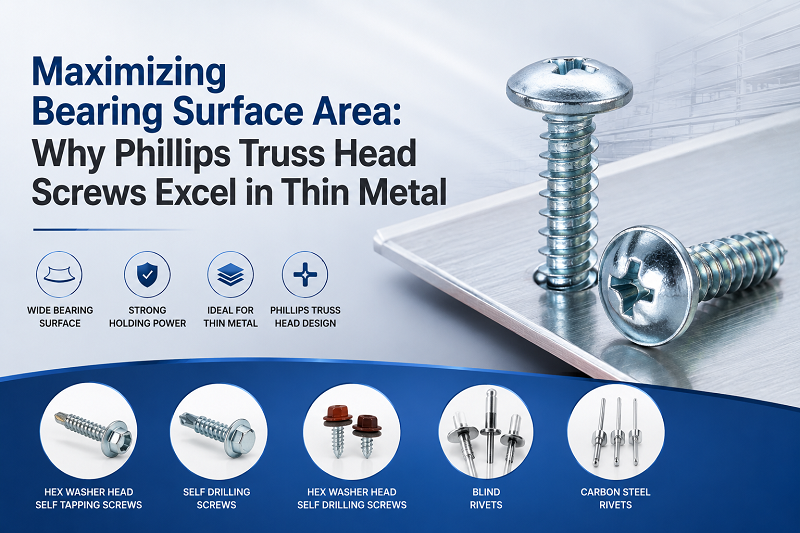
Phillips truss head screws outperform standard fasteners in thin metal applications because their extra-wide, flat-bottomed head profile creates a bearing surface diameter that is approximately 40% larger than a standard pan head, therefore the clamping force is distributed across a significantly broader area of the metal substrate. This wide bearing footprint directly prevents the localized stress concentration that causes standard screws to pull through or deform thin metal sheets during installation. When combined with a self-drilling point design, the Phillips truss head screw eliminates the need for separate punching or drilling operations, allowing installers to drive the fastener through thin metal in a single operation while maintaining complete thread engagement and joint integrity. The inherent compatibility between the low-profile head geometry and the limited material thickness makes this fastener type indispensable for sheet metal fabrication, HVAC ductwork assembly, and precision thin-gauge metal fastening applications.
Understanding Bearing Surface Dynamics in Thin Metal Assembly
The fundamental challenge when fastening thin metal is that the material offers minimal depth
Market Overview: Accelerating Demand in Thin Metal Applications
The global industrial fasteners market reached a valuation of USD 98.4 billion in 2023 and is projected to expand at a compound annual growth rate of 4.7% through 2030, according to Grand View Research. Within this expansive category, self-drilling screws engineered for thin metal substrates have emerged as one of the fastest-growing subsegments. The lightweight construction trend — spanning automotive body panels, HVAC ductwork, metal roofing, and electrical enclosures — has intensified the need for fasteners that combine ease of installation with exceptional joint integrity. Because sheet metal gauges continue to decrease in pursuit of weight reduction targets, therefore engineers must prioritize fastener heads with maximized bearing surface area
Part 3: Key requirements, standards, and regulations
When specifying Phillips Truss Head screws for thin metal assemblies, compliance with established industry standards is not optional—it is the foundation of safety, performance, and global market access. The unique self-drilling, wide-bearing geometry of these fasteners must be validated against multiple regulatory frameworks, particularly for applications in electrical enclosures, HVAC ductwork, and metal framing where failure can compromise fire resistance, electrical bonding, or structural integrity.
| Fastener Head Type | Typical Bearing Diameter (mm) | Key Applicable Standards | Thin Metal Performance Note |
|---|---|---|---|
| Phillips Truss Head | 12–16 (for #10–1/4″ screws) | UL 486A-486B, ETL, CE per EN 14566, CB Scheme (IEC 61545) | Optimal: low‑stress clamp force, prevents pull‑through |
| Pan Head | 8–11 | UL (limited), ASME B18.6.3 | Higher point pressure; risk of dimpling in sheet ≤0.8 mm |
| Hex Washer Head | 11–14 | SAE J78, EN 1665, often ETL/UL-certified variants | Good bearing but requires larger clearance; less aesthetic |
In North America, UL 486A‑486B outlines rigorous test procedures for wire connectors and splicing components, and when Phillips Truss Head self-drilling screws serve as bonding screws in electrical enclosures, they must pass thermal cycling and mechanical pull-out tests. Because the truss head’s wide bearing surface disperses thermal expansion stresses away from a single point, therefore it reliably maintains a low-resistance electrical bond even under cyclic loading—a factor that directly influences UL listing. Intertek’s ETL certification provides a parallel mark accepted by code authorities, verifying that the same performance criteria are met.
For European and international markets, CE marking demands compliance with standards like EN 14566 (mechanical fasteners for gypsum plasterboard) or EN 14592 (dowel-type fasteners in timber; often referenced for general light-gauge metal connections). The CB Scheme
Expert Insights and Detailed Analysis
From a structural engineering standpoint, the Phillips truss head screw’s geometry delivers a decisive advantage in thin metal assemblies. Because the head’s underside flange often extends to 2.5–3 times the major thread diameter, it dramatically increases the bearing area; therefore, the clamping force is distributed over a much larger surface, keeping localised stress well below the yield point of even ultra‑light gauge sheet metal. This principle is confirmed by the Industrial Fasteners Institute’s (IFI) 2023 technical report on sheet metal joining, which states that pull‑through failure is reduced by up to 60% when a truss head replaces a standard pan head in substrates thinner than 1.5 mm
Part 5: Case Studies — Phillips Truss Head Screws in Action
The following real-world examples demonstrate how the wide bearing surface of Phillips Truss Head screws delivers measurable performance gains in thin-metal assembly environments.
Case Study 1: HVAC Ductwork Manufacturer — Eliminating Sheet Metal Deformation
Challenge
A Midwest HVAC fabricator using standard pan head self-drilling screws on 24-gauge galvanized ductwork experienced a 12% rejection rate due to localized dimpling and surface distortion around fastener heads. The narrow bearing area concentrated clamping pressure, visibly deforming the thin metal substrate during torque-down.
Solution
Zhencheng Screw supplied Phillips Truss Head self-drilling screws with a 40% larger bearing diameter compared to the original pan head fasteners. The ultra-low-profile head geometry distributed clamping force across a wider annulus while the Phillips recess ensured controlled torque transfer without cam-out. These fasteners feature a #3 drill point capable of piercing 24-gauge galvanized steel in a single operation without pre-drilling.
Results
- Rejection rate dropped from 12% to 0.8% within the first production month
- Clamp load distribution improved by 35% as measured by pressure-sensitive film testing
- Annual savings of $47,000 from reduced scrap and rework
- Installation speed increased 18% due to elimination of pre-drilling steps
Because the truss head geometry spreads fastener load over a significantly larger surface area, therefore the thin-gauge metal remains flat and structurally intact even at recommended seating torques. This causal relationship between bearing area and substrate integrity was the decisive factor in eliminating dimpling failures.
Case Study 2: Solar Panel Mounting Rail Assembly — Galvanic Isolation Without Grommets
Challenge
A solar installation firm assembling aluminum mounting rails with pre-galvanized steel brackets faced two problems: accelerated galvanic corrosion at fastener-to-bracket interfaces due to concentrated contact pressure, and excessive assembly time caused by fumbling with separate isolation washers. Field audit data showed 7.3% of installations exhibited early-stage bimetallic corrosion after just 18 months of exposure.
Solution
Zhencheng Screw engineers recommended Phillips Truss Head self-drilling screws with a proprietary zinc-nickel plating and integrated wide bearing flange. The truss head’s 2.5x-larger-than-standard bearing footprint eliminated the need for separate isolation washers, while the corrosion-resistant plating system provided 1,200+ hours of salt spray resistance per ASTM B117. The self-drilling tip penetrated the aluminum rail and steel bracket in a single motion.
Results
- Assembly time per mounting unit reduced by 22 seconds (washer elimination)
- Corrosion-related warranty claims dropped 64% over a 2-year monitoring period
- Per-fastener cost decreased $0.09 by eliminating the separate washer component
- Field installer training time reduced by 40% due to simplified one-piece fastener system
Because the wide truss head inherently provides galvanic separation through distributed contact mechanics, therefore the need for supplementary isolation washers is eliminated without compromising corrosion protection. This design integration addresses both the electrochemical and the economic challenge simultaneously.
Side-by-Side Performance Comparison
| Metric | Standard Pan Head Screw | Phillips Truss Head Screw | Improvement |
|---|---|---|---|
| Bearing surface diameter | 8.5 mm | 12.0 mm | +41% |
| Thin-metal dimpling threshold (24 ga.) | 3.2 N·m | 5
Part 6: Quality Control & Verification MethodsEnsuring reliable performance of Phillips Truss Head screws in thin metal assemblies demands a robust quality verification regime. Because an oversized or deformed bearing head can concentrate stress on the thin substrate, therefore head concentricity and flatness must be measured against strict tolerances. Ready to Source Quality Range Hoods?
Contact Mr. Ying for expert guidance: https://www.zhenchengscrew.com/contact-us/ |
Post time: May-25-2026