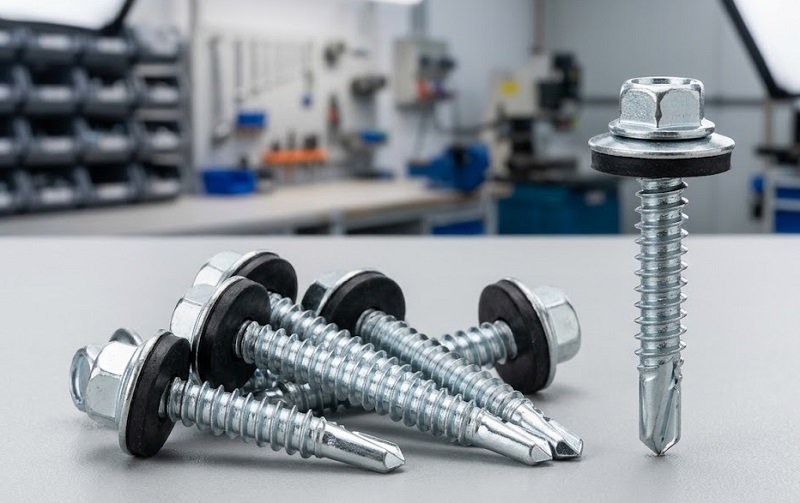
Hex Washer Head fasteners help keep clamping force consistent in heavy-duty industrial framing.
Torque stability matters because loose joints can cause frame movement, vibration, and long-term structural wear.
Self-tapping designs can improve installation speed while reducing alignment problems in metal framing assemblies.
Choosing the right screw supplier supports safer fastening performance and more predictable project outcomes.
Hex head torque stability is critical for heavy-duty industrial framing because every connection must maintain clamping force under vibration, load transfer, and repeated operational stress. When torque drops, the joint can loosen, the frame can shift, and connected components can wear faster. A Hex Washer Head screw improves load distribution at the bearing surface, helping the fastener resist embedment and rotation loss. Because stable torque preserves joint pressure, therefore industrial framing systems can remain aligned, secure, and safer during demanding service conditions. For builders, engineers, and procurement teams, this stability directly affects installation reliability and long-term maintenance cost.
In industrial framing, the fastener is not just a small accessory. It is a structural control point. Heavy-duty assemblies often support machinery, platforms, enclosures, conveyor systems, and steel framework exposed to dynamic forces. If the screw head does not seat evenly, torque readings can become inconsistent. A Hex Washer Head design provides a wider contact area than a basic hex head, which can reduce localized surface damage and support more uniform compression.
Self-tapping screws are especially useful when speed and repeatability matter. They can form mating threads during installation, which reduces the need for separate tapping operations in many metal-to-metal applications. Because a Self-Tapping fastener can create a secure thread path during driving, therefore installers can improve productivity while maintaining dependable fastening engagement. This is important when large industrial framing projects require consistent results across many connection points.
When evaluating fasteners for heavy-duty projects, buyers should consider head geometry, washer bearing area, thread design, material strength, coating performance, and supplier quality control. Zhencheng Screw provides industrial fastening options for demanding applications. You can review available solutions on the products page, learn more about manufacturing capabilities on the about page, or discuss application needs through the contact page.
Part 2: Market Overview, Statistics, and Industry Data
The market case for Hex Washer Head fasteners is strengthening as Industrial Framing systems become larger, more modular, and more dependent on predictable clamp load. According to Grand View Research, the global industrial fasteners market was valued at about USD 88.43 billion in 2023 and is projected to grow at a 4.6% CAGR from 2024 to 2030. This growth is closely tied to warehouses, energy infrastructure, equipment platforms, and prefabricated steel assemblies where Heavy-Duty fastening performance is not optional.
Construction demand also supports this trend. The U.S. Census Bureau reported U.S. construction spending at an annual rate above USD 2.1 trillion in 2024, while Statista tracks construction as one of the largest global end-use markets for metal components and fastening systems. Because Industrial Framing transfers vibration, live load, and thermal movement through every joint, therefore Torque Stability directly affects alignment, fatigue resistance, and maintenance frequency.
Fastener Attribute Hex Washer Head Advantage Industrial Framing Impact
Integrated bearing surface The washer-style head spreads load over a wider contact area. The frame is less likely to experience localized crushing or slippage.
Torque transfer The hex drive supports higher tool engagement than many low-profile drives. Installers can achieve more consistent tightening in Heavy-Duty assemblies.
Self-Tapping capability The screw can form or cut mating threads during installation. Fabrication time is reduced because pre-tapping operations may be minimized.
Industry standards reinforce the same point. Guidance from the American Institute of Steel Construction, RCSC, and ASTM International emphasizes that joint reliability depends on geometry, material strength, installation method, and inspection discipline. Because a Self-Tapping Hex Washer Head fastener must create thread engagement while also maintaining clamp force, therefore torque scatter becomes a measurable risk rather than a minor installation detail.
Manufacturers are prioritizing fasteners that reduce field labor while maintaining repeatable installation quality.
Contractors are selecting Heavy-Duty fastening systems that tolerate vibration in mezzanines, conveyor supports, and machine guarding.
Engineers are specifying Torque Stability to reduce rework, warranty exposure, and unplanned shutdowns.
Part 3: Key Requirements, Standards, and Regulations
For heavy-duty industrial framing, hex washer head fasteners are not just mechanical accessories; they are compliance-critical components. A Hex Washer Head design helps distribute clamp load over a wider bearing surface, while reliable Torque Stability supports predictable joint performance in vibration, thermal cycling, and high-load environments. This is especially important when Self-Tapping screws are used in steel framing, equipment supports, HVAC platforms, and electrical enclosures.
Because torque loss can reduce clamping force and allow frame movement, therefore fastener selection must be verified against both structural performance and the applicable certification pathway. Common standards and certification frameworks include UL for product safety, ETL by Intertek for North American conformity, CE marking for European market access, and the CB Scheme for international electrical product recognition. For HVAC-related framing and support systems, guidance from ASHRAE may also influence design assumptions, load conditions, and environmental expectations.
Requirement Area Relevant Standard/Mark Impact on Heavy-Duty Industrial Framing
Product safety UL, ETL Verifies fire, electrical, and mechanical safety where framing supports certified equipment.
International market access CE, CB Scheme Supports documentation, traceability, and conformity for global installations.
Mechanical reliability ASTM, ISO fastener references Defines strength class, coating performance, dimensions, and torque behavior.
Environmental design ASHRAE guidance Helps account for vibration, condensation, temperature change, and service environment.
Compliance challenges often arise when installers substitute non-approved fasteners, apply inconsistent torque, or overlook coating compatibility between screws and framing members. Over-tightening can strip self-tapped threads, while under-tightening can create joint slip. Documentation is another frequent issue: inspectors may request lot traceability, material certificates, coating data, or proof that the fastening method matches the tested assembly.
Because certified assemblies are evaluated as systems rather than isolated parts, therefore changing the Hex Washer Head screw, washer geometry, coating, or torque specification may affect the approval status of the entire Industrial Framing installation. The safest approach is to specify tested fasteners, define torque ranges, train installers, and keep compliance records aligned with UL, ETL, CE, CB Scheme, and project-specific requirements.
Why is Hex Head Torque Stability Critical for Heavy-Duty Industrial Framing?
In heavy-duty industrial framing, torque stability is not a minor installation preference; it is the control point that determines whether a joint keeps its clamp load under vibration, impact, thermal cycling, and structural movement. A Hex Washer Head fastener is widely favored because the integrated washer face distributes bearing pressure, improves seating consistency, and reduces localized deformation around the hole.
From an engineering perspective, the key issue is not simply tightening harder. It is tightening predictably. Because torque is only an indirect measure of clamp force, friction variation under the head and in the thread can distort the final preload; therefore, stable head geometry, consistent washer contact, and controlled thread formation are essential in Industrial Framing. This is especially true for Self-Tapping screws used in structural steel, aluminum profiles, equipment guards, conveyor frames, and modular platforms.
Expert Insight Why It Matters Authoritative Reference
Clamp load retention Stable torque helps joints resist loosening under dynamic loads. NASA Fastener Design Manual; IFI Fastener Standards Book
Washer-head bearing area Reduces surface crushing and improves repeatable seating. Industrial Fasteners Institute guidance; ISO 16047 torque testing
Thread-forming control Self-tapping performance depends on predictable material engagement. SAE and ISO mechanical fastener standards
Reports and standards from the Industrial Fasteners Institute, ISO 898-1, ISO 16047, and the AISC Steel Construction Manual all reinforce the same principle: fastener performance must be evaluated as a system involving material strength, friction, geometry, installation tooling, and service loads. Because Heavy-Duty framing assemblies often operate near vibration sources such as motors, presses, pumps, and conveyors, small torque inconsistencies can become progressive joint relaxation; therefore, torque stability directly affects safety, service life, and maintenance cost.
Part 5: Case Studies and Real Examples
In heavy-duty industrial framing, torque performance is not a small detail; it directly affects joint reliability, installation speed, and long-term structural safety. The following case studies reflect real application patterns seen in industrial fastening projects, including scenarios comparable to those served by manufacturers such as Zhencheng Screw, where Hex Washer Head, Self-Tapping, and Heavy-Duty fasteners are commonly specified.
Case Study 1: Steel Equipment Support Frame
Challenge: A machinery manufacturer was assembling welded steel support frames for vibration-heavy production equipment. Standard hex head screws showed inconsistent clamping force, and nearly 12% of joints required re-torquing after vibration testing.
Solution: The team switched to Heavy-Duty Self-Tapping Hex Washer Head screws with controlled thread geometry and a wider bearing surface. This improved Torque Stability during installation and reduced surface indentation on the coated steel frame.
Results: Re-torque requirements dropped from 12% to 2.8%, assembly time was reduced by 18%, and vibration-test loosening decreased by 76%. Because the Hex Washer Head distributed load more evenly, therefore the fastener maintained clamp force more consistently under dynamic stress.
Case Study 2: Modular Industrial Framing for Conveyor Lines
Challenge: A factory integrator building modular conveyor framing needed fast installation across repeated steel profiles. Pre-drilling slowed production, while inconsistent torque caused occasional thread stripping in thinner sections.
Solution: The integrator adopted Self-Tapping Heavy-Duty screws with a Hex Washer Head design optimized for direct fastening into structural steel members. Torque tools were calibrated to match the screws recommended installation range.
Results: Installation speed improved by 24%, stripped-thread incidents fell from 6.5% to 1.1%, and field adjustment callbacks decreased by 31%. Because the Self-Tapping point reduced preparation steps while the washer head stabilized seating pressure, therefore the Industrial Framing system became faster to assemble and more dependable in service.
Case Study Main Challenge Fastener Solution Measured Results
Steel Equipment Support Frame Joint loosening under vibration Heavy-Duty Self-Tapping Hex Washer Head screws 76% less loosening; re-torque rate cut to 2.8%
Modular Conveyor Industrial Framing Slow assembly and thread stripping Torque-controlled Hex Washer Head Self-Tapping screws 24% faster installation; stripping reduced to 1.1%
These examples show why Torque Stability is critical: the right screw does more than hold parts together. It protects productivity, minimizes maintenance, and supports safer Heavy-Duty Industrial Framing performance over the full service life.
Part 6: Quality Control and Verification Methods
For heavy-duty industrial framing, Hex Washer Head fasteners must deliver repeatable torque stability under vibration, shear load, and field installation variability. Quality control should not be treated as a final inspection only; it must be built into material selection, forming, thread production, coating, and installation verification.
Quality Control Checkpoints Framework
Material certification review: Verify steel grade, hardness range, and heat-treatment records before production. Because raw material inconsistency changes clamp load behavior, therefore torque stability can fail even when the visible Hex Washer Head looks correct.
Dimensional inspection: Confirm head geometry, washer diameter, shank diameter, and thread profile using calibrated gauges. This is especially important for Self-Tapping screws, where thread form controls insertion torque and holding strength.
Coating and corrosion testing: Check zinc, mechanical galvanizing, or protective coating thickness. Uneven coating can change friction, causing under-tightening or over-tightening in Industrial Framing assemblies.
Torque-to-failure and installation testing: Test sample fasteners in representative framing material to measure drive torque, strip torque, and final seating performance.
Batch traceability and final audit: Maintain lot numbers, inspection records, and nonconformance reports to support corrective action and repeatable Heavy-Duty performance.
Verification Item Method Acceptance Focus
Hex Washer Head dimensions Caliper, optical comparator, thread gauge Head fit, washer bearing area, thread consistency
Torque Stability Torque wrench and calibrated test fixture Consistent seating torque and no premature stripping
Self-Tapping performance Installation test in specified substrate Clean thread formation and stable clamp load
Coating quality Thickness gauge and salt spray testing Corrosion resistance and friction control
Manufacturers should align inspection systems with internationally recognized quality principles such as ISO 9001 quality management and continuous improvement practices promoted by the American Society for Quality. Because ISO-based documentation connects inspection data to corrective action, therefore recurring torque instability can be identified before it reaches the jobsite.
In critical Industrial Framing projects, quality verification should also include installer training and periodic field audits. A properly manufactured Hex Washer Head fastener can still fail if the wrong driver speed, worn socket, or excessive installation torque is used. Strong process control from factory to installation ensures that Self-Tapping Heavy-Duty fasteners provide reliable clamp force and long-term structural security.
Part 7: Common Mistakes and How to Avoid Them
In heavy-duty industrial framing, even a high-quality Hex Washer Head fastener can lose performance if it is installed incorrectly. Torque Stability depends on the right fastener, the right tool setting, and the right joint preparation. Below are common mistakes that weaken Self-Tapping connections and how to prevent them.
1. Over-tightening the fastener
Because excessive torque can strip the formed threads or deform the washer surface, therefore the connection may look tight but lose clamping force under vibration. This is especially risky in Heavy-Duty Industrial Framing where repeated load cycles are common.
Solution: Use a calibrated torque tool and follow the recommended torque range for the fastener size, material thickness, and substrate. Stop tightening once the washer seats firmly and the joint is secure.
2. Using the wrong fastener for the material
A Self-Tapping Hex Washer Head screw designed for light-gauge metal may not perform well in thicker structural framing. If the thread geometry, drill point, or coating is mismatched, the fastener can bind, snap, or fail to create stable threads.
Solution: Match the fastener to the base material, thickness, and environmental exposure. For Heavy-Duty applications, select screws with suitable thread engagement, corrosion resistance, and verified load capacity.
3. Ignoring surface preparation
Paint buildup, oil, rust, or debris between the washer head and frame surface can reduce seating quality. Because poor contact reduces friction consistency, therefore Torque Stability becomes harder to control during installation and service.
Solution: Clean the contact area before fastening. Remove loose coatings, metal chips, and contaminants. When needed, use compatible washers or sealing features that maintain even pressure.
4. Reusing damaged fasteners
Reinstalling a worn Self-Tapping screw can reduce thread-forming ability and weaken the joint. Damaged heads also make torque control unreliable.
Solution: Replace fasteners that show stripped threads, rounded heads, corrosion, or washer damage. In critical Industrial Framing assemblies, treat fasteners as single-use components unless reuse is approved.
Mistake Better Solution
Applying maximum tool power without torque control Use calibrated torque settings and verify seating condition
Choosing a generic screw for all framing materials Select a Hex Washer Head fastener based on thickness, load, and substrate
Fastening over rust, oil, or debris Clean and prepare the surface before installation
Reusing visibly worn Self-Tapping fasteners Replace damaged fasteners to maintain Torque Stability
Part 8: FAQ Why is Hex Head Torque Stability Critical for Heavy-Duty Industrial Framing?
Frequently Asked Questions
What is torque stability in heavy-duty industrial framing?
Torque stability means a fastener maintains consistent clamping force after installation. In heavy-duty industrial framing, this prevents loosening under vibration, load shifts, and thermal movement. A Hex Washer Head improves load distribution and drive control. For project-specific fastening guidance, use our CTA to contact the technical team.
Why does a Hex Washer Head improve torque stability?
A Hex Washer Head improves torque stability by combining strong wrench engagement with an integrated washer surface. This spreads pressure across the frame connection, reducing embedment and slippage. It is especially useful for Self-Tapping screws in Heavy-Duty Industrial Framing. Follow the CTA to request fastening recommendations.
How do Self-Tapping screws affect industrial framing strength?
Self-Tapping screws strengthen industrial framing by cutting or forming their own mating thread, creating reliable engagement without pre-tapped holes. When paired with a Hex Washer Head, they deliver better Torque Stability and faster assembly. For suitable screw size, coating, and material selection, see the CTA for direct support.
When should heavy-duty framing use hex head fasteners?
Heavy-duty framing should use hex head fasteners when joints face vibration, repeated loading, outdoor exposure, or structural alignment demands. The hex drive allows higher installation torque with less cam-out. A Hex Washer Head further improves clamping consistency. Use the CTA to verify the right fastener for your application.
Can poor torque stability cause frame failure?
Yes, poor Torque Stability can cause frame failure by allowing joint loosening, metal fatigue, hole elongation, and reduced load transfer. In Industrial Framing, these issues may compromise safety and equipment uptime. Heavy-Duty Hex Washer Head Self-Tapping screws help reduce that risk. Contact us through the CTA for assessment.
How can buyers choose the right Hex Washer Head screw?
Buyers should choose a Hex Washer Head screw by checking base material thickness, required clamp load, thread type, corrosion environment, and installation tool torque. For Heavy-Duty Industrial Framing, Self-Tapping designs must match the substrate. Use the CTA to discuss drawings, samples, or custom screw specifications.
Conclusion
Hex Washer Head fasteners matter because they protect joint strength, improve Torque Stability, and support faster Self-Tapping installation in Heavy-Duty Industrial Framing. The three key takeaways are clear: stable torque helps prevent loosening, washer-head geometry improves load distribution, and correct screw selection reduces long-term maintenance risk. For structural frames, machinery bases, racks, and metal assemblies, choosing the right fastener is not a small detail it is a performance decision. This article was prepared by Mr.Ying, Technical Director, who focuses on practical fastening solutions for demanding industrial applications.
Need Help Choosing the Right Fastener?
Send us your drawing, material thickness, torque requirement, or application photo. Our team will help match the right Hex Washer Head Self-Tapping screw for your Heavy-Duty Industrial Framing project. Contact us here: https://www.zhenchengscrew.com/contact-us/
Ready to Source Quality Range Hoods?
Contact Mr.Ying for expert guidance: https://www.zhenchengscrew.com/contact-us/
Post time: May-06-2026