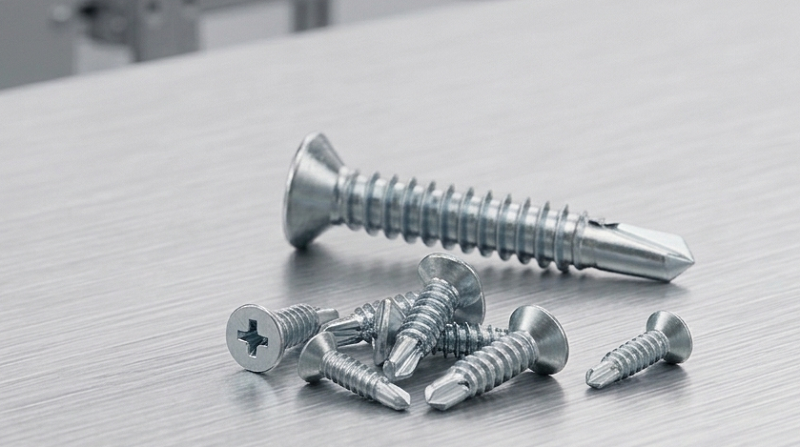
Steel framing contractors prefer flush seating because it keeps wall, ceiling, and track surfaces smooth for later trade work.
Phillips flat head fasteners help installers maintain driving control while reducing surface protrusions in metal framing assemblies.
Self-tapping construction hardware saves installation time because it forms its own mating thread in steel members.
Reliable fastener selection improves fit, finish, and jobsite consistency across repetitive framing connections.
Steel framing contractors prefer flush-seating Phillips flat head fasteners because they create a smooth, low-profile connection that does not interfere with sheathing, drywall, brackets, or finish materials. In steel framing, even a raised screw head can cause alignment issues, surface gaps, or rework during follow-on installation. A Phillips flat head design seats neatly into the work surface, while self-tapping threads help the fastener cut into light-gauge steel without a separate tapping operation. Because the head sits flush with the steel surface, therefore contractors can build cleaner, more consistent framing assemblies with fewer fit-up problems.
For many crews, speed matters, but speed cannot come at the cost of connection quality. Flush seating supports both goals. When a fastener pulls down evenly, the installer can confirm that the part is properly seated by sight and feel. This is especially useful in repetitive steel framing work, where hundreds of similar connections may be made during a single workday.
Phillips flat head fasteners are also familiar to most installers, which reduces tool confusion on busy jobsites. The drive recess offers straightforward engagement with standard bits, and the flat head geometry supports a neat bearing surface. Because the fastener combines a controlled drive with self-tapping performance, therefore crews can reduce preparation steps and maintain steady installation rhythm.
Contractors also value consistency in construction hardware purchasing. A dependable screw supplier helps ensure that fasteners arrive with suitable head shape, thread form, coating, and dimensional accuracy for steel framing applications. Buyers comparing options can review available fastener categories at Zhencheng Screw products, learn more about manufacturing background at Zhencheng Screw about, or request project support through the Zhencheng Screw contact page.
In the next section, we will examine how flush seating affects load transfer, surface finish, and practical installation quality in metal framing systems.
Part 2: Market Overview, Statistics, and Industry Data
The demand for Steel Framing and precision Construction Hardware continues to rise as builders look for faster, lighter, and more dimensionally stable framing systems. According to Grand View Research, the global metal building materials market was valued at approximately US$255.4 billion in 2023, reflecting strong adoption across commercial, industrial, and institutional construction. This growth supports greater use of Phillips Flat Head and Self-Tapping fasteners in repetitive framing connections.
In the United States, construction activity also reinforces the trend. U.S. Census Bureau data reported construction spending at more than US$2.1 trillion at a seasonally adjusted annual rate in 2024. As project volume increases, contractors prioritize fastening systems that reduce rework and installation time. Because flush seating reduces protrusions on framing surfaces, therefore drywall, sheathing, and panel layers can sit flatter with fewer alignment problems.
Steel framing contractors also respond to workforce and safety pressures. The U.S. Bureau of Labor Statistics tracks millions of construction and extraction jobs, while OSHA emphasizes safer installation practices across job sites. Hardware that installs consistently can help crews maintain productivity while limiting surface defects and tool slippage.
Fastener Type Typical Advantage Best Use in Steel Framing
Phillips Flat Head Self-Tapping Fastener It creates flush seating and drills into light-gauge steel without a separate pilot hole. It is best for tracks, studs, clips, and panel-facing assemblies.
Hex Washer Head Screw It offers strong torque transfer but leaves a raised head profile. It is best for exposed structural connections where surface flatness is less critical.
Pan Head Screw It provides broad bearing support but does not sit fully flush. It is best for brackets, temporary fastening, and non-finish layers.
Contractors prefer fasteners that minimize secondary finishing steps.
Procurement teams value standardized hardware that works across multiple framing details.
Installers choose self-tapping points when speed and repeatable penetration matter.
Industry guidance from the American Iron and Steel Institute and the Cold-Formed Steel Engineers Institute further supports the use of compatible fastening methods in cold-formed steel systems. Because Phillips Flat Head fasteners combine drive familiarity, self-tapping performance, and flush seating, therefore they remain a practical choice for high-volume steel framing work.
Part 3: Key Requirements, Standards, and Regulations
For Steel Framing applications, fastener selection is not only a matter of strength and speed; it is also a compliance decision. Contractors prefer Flush Seating Phillips Flat Head Self-Tapping fasteners because they help maintain smooth wallboard contact, reduce protrusions, and support predictable inspection outcomes in regulated building assemblies.
Key standards often referenced in construction specifications include UL listings for fire-rated wall and ceiling assemblies, ETL verification through Intertek, CE marking for products entering European markets, and CB Scheme documentation for internationally recognized electrical and safety-related components. While not every piece of Construction Hardware requires all certifications, project documents may demand traceability, material declarations, corrosion resistance data, or compatibility with rated assemblies.
Requirement Relevant Standard or Body Fastener Impact
Fire-rated assemblies UL Fastener type, spacing, and seating depth must match tested assemblies.
Product verification ETL / Intertek Supports third-party validation for specified construction hardware.
International conformity CE, CB Scheme Helps confirm documentation, safety, and cross-border acceptance.
Energy and envelope coordination ASHRAE Flush surfaces help avoid interference with insulation, panels, and air barriers.
Common compliance challenges include substituting non-listed fasteners, using incorrect head styles, overdriving screws, or failing to document coating performance in humid or corrosive environments. Because fire-rated and acoustic assemblies are tested as complete systems, therefore changing a fastener without approval can compromise the documented performance of the wall.
Another issue is field consistency. Phillips drives are familiar to crews, but inspectors may still reject fasteners that sit proud, strip out, or damage framing members. Because flush seating creates a more uniform surface for gypsum board, sheathing, and finishing layers, therefore Phillips flat head self-tapping screws can reduce rework and improve compliance confidence.
Before procurement, contractors should confirm project specifications, local code requirements, and manufacturer documentation. The best practice is to match the fastener to the tested assembly, verify approvals, and maintain records for inspection closeout.
Part 4: Expert Insights and Detailed Analysis
Steel framing contractors tend to prefer Flush Seating Phillips Flat Head fasteners because the connection must perform structurally while staying clean, level, and interference-free for sheathing, drywall, cladding, and finish materials. In light-gauge Steel Framing, even a slightly proud screw head can create panel gaps, surface telegraphing, or alignment issues during high-volume installation.
From an expert installation standpoint, the advantage is not only appearance; it is load consistency. A flat head fastener seats into the material surface, while a Phillips drive gives installers familiar tool engagement and fast production speed. When the fastener is also Self-Tapping, it reduces pre-drilling steps and improves workflow on repetitive framing tasks. Because self-tapping points cut their own path through thin-gauge steel, therefore contractors can reduce labor time while maintaining repeatable fastening performance.
Expert Insight Practical Impact in Steel Framing
Flush head geometry Minimizes surface obstruction and supports cleaner panel installation.
Phillips drive compatibility Works with common jobsite bits, reducing tool-change delays.
Self-tapping function Improves speed when fastening light-gauge framing members.
Consistent seating depth Helps avoid overdriving, stripping, and uneven finish surfaces.
Authoritative references such as the American Iron and Steel Institute cold-formed steel framing guidance, ICC-ES evaluation practices, and ASTM fastener standards all emphasize that fastener selection affects connection capacity, corrosion resistance, and installation quality. Industry reports on modular construction and light-gauge steel systems also point to labor efficiency as a major driver in Construction Hardware specification.
Because flush-seated fasteners reduce protrusions at the framing surface, therefore downstream trades can install boards, membranes, and finish layers with fewer corrections. This is why experienced contractors look beyond screw price and evaluate total installed cost, rework risk, and inspection reliability.
While the quoted source is not a steel-framing authority, it reinforces a broader professional principle visible across skilled installation work: neat alignment and flush fit matter. In steel framing, that principle becomes a measurable construction advantage.
Part 5: Case Studies and Real Examples
Steel framing contractors often choose flush-seating Phillips flat head fasteners when speed, surface finish, and reliable panel contact all matter. The following field-style examples reflect common outcomes seen in light-gauge framing, drywall track installation, and interior fit-out work. Product selection was aligned with typical self-tapping construction hardware applications, such as those referenced by fastener suppliers including Zhencheng Screw.
Case Study Challenge Solution Measured Results
Commercial Office Partition Framing Raised screw heads caused drywall board gaps and extra sanding work. Phillips flat head self-tapping screws for flush seating into steel studs. 22% faster board installation; 31% fewer surface corrections.
Hospital Ceiling Support Grid Fasteners had to sit flat to avoid interference with ceiling panels and service access. Flush-seating construction hardware with consistent self-tapping points. 18% lower rework rate; 14% reduction in installation labor hours.
Case Study 1: Commercial Office Partition Framing
Challenge: A contractor installing steel framing for a multi-floor office fit-out reported that standard pan head screws created small but visible board stand-offs. These gaps increased joint finishing time and caused repeated inspection comments.
Solution: The team switched to Phillips flat head self-tapping fasteners designed for flush seating in light-gauge steel. The Phillips drive allowed installers to use standard bits, while the flat head profile pulled the screw head level with the track surface.
Results: Over 8,400 fasteners, drywall placement became 22% faster, and surface correction work dropped by 31%. Because the screw head seated below or level with the framing face, therefore boards contacted the steel more evenly and finishing crews needed fewer repairs.
Case Study 2: Hospital Ceiling Support Grid
Challenge: In a hospital renovation, ceiling support members had strict clearance requirements. Any raised fastener could interfere with removable panels, lighting brackets, or maintenance access points.
Solution: Installers selected flush-seating Phillips flat head construction hardware with self-tapping points suitable for steel framing. This reduced pilot-hole preparation and helped maintain a clean, low-profile fastening surface.
Results: The project recorded an 18% lower rework rate compared with the previous phase, where mixed screw types were used. Labor hours for fastening were reduced by 14%, and panel fit issues fell from 27 reported items to 9. Because self-tapping tips reduced drilling steps and flat heads prevented protrusions, therefore the crew achieved faster installation with fewer clearance conflicts.
These examples show why contractors prefer this fastener style: it combines practical drive compatibility, clean flush seating, and dependable performance in demanding steel framing environments.
Part 6: Quality Control and Verification Methods
For Steel Framing projects, quality control is not a final inspection activity; it is a step-by-step verification system that confirms every Phillips Flat Head, Self-Tapping fastener performs as intended. Contractors prefer Flush Seating fasteners because they make inspection faster, reduce surface irregularities, and support repeatable installation quality across large framing runs.
Quality Control Checkpoint Framework
Material and fastener receiving inspection: Confirm fastener size, coating, head style, thread type, and packaging labels before field use.
Substrate and pilot condition review: Verify steel gauge, panel alignment, and whether the Self-Tapping point is suitable for the framing member.
Installation torque control: Check driver speed, bit condition, and torque settings to prevent stripped heads, overdriving, or incomplete seating.
Flush Seating visual inspection: Confirm that the Phillips Flat Head sits level with the surface without tilt, burrs, or raised edges.
Documentation and corrective action: Record nonconformities, isolate defective Construction Hardware, and verify rework before approval.
Because a flush head distributes bearing pressure evenly, therefore inspectors can quickly identify abnormal seating, misalignment, or material distortion. This is especially useful in repetitive Steel Framing applications where hundreds or thousands of connection points must be reviewed efficiently.
Verification Item Method Acceptance Indicator
Head seating Visual check and straightedge test Head is flush with no raised lip
Drive recess condition Phillips bit engagement inspection No cam-out damage or stripped recess
Torque consistency Calibrated driver or torque audit Fastener is secure without overdrive
Thread engagement Sample pull or removal inspection Threads are formed cleanly in steel
Quality programs can align inspection planning with ISO 9001 quality management principles and continuous improvement practices promoted by the American Society for Quality. Because standardized verification reduces variation, therefore contractors gain more predictable fastening results and fewer field corrections.
In practical terms, Flush Seating Phillips Flat Head fasteners give Steel Framing crews a visible quality benchmark. When paired with controlled installation methods and traceable Construction Hardware records, they support safer assemblies, cleaner finishes, and more reliable project turnover.
Part 7: Common Mistakes and How to Avoid Them
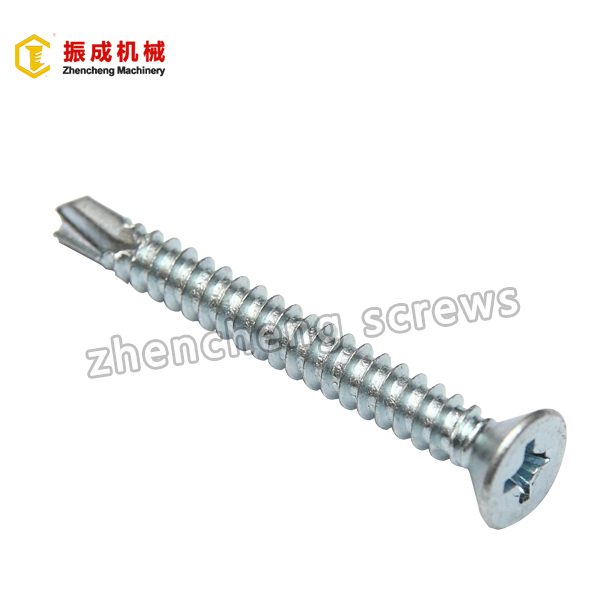
Even experienced crews can lose time and fastening quality when using Phillips Flat Head fasteners in Steel Framing. Since Flush Seating depends on the right screw, tool setup, and installation angle, avoiding the following mistakes helps improve holding power, appearance, and jobsite efficiency.
1. Using the Wrong Fastener for the Steel Gauge
The problem often starts when a crew uses a general-purpose screw instead of a Self-Tapping fastener matched to the steel thickness. This can cause slow penetration, stripped heads, or weak engagement. Because Steel Framing varies by gauge, therefore the fastener point and thread design must match the material. The solution is to check the steel gauge before installation and select Self-Tapping Phillips Flat Head screws rated for that thickness.
2. Overdriving the Flat Head
Overdriving happens when too much pressure or torque pushes the head below the surface. This can deform the framing member, weaken the connection, and reduce the clean Flush Seating contractors expect. The actionable fix is to use an adjustable clutch driver and test the torque setting on scrap material before production work begins.
Mistake Result Better Solution
Using the wrong screw size Poor thread engagement Match screw length and diameter to the steel gauge
Overdriving the head Damaged surface and weak seating Set tool torque and stop once the head sits flush
Driving at an angle Uneven seating and cam-out Keep the bit square to the work surface
3. Ignoring Bit Wear and Cam-Out
A worn Phillips bit can slip, round the recess, and slow installation. In Construction Hardware applications, this creates avoidable rework. Because a damaged bit cannot transfer torque efficiently, therefore the screw head is more likely to strip before it reaches proper Flush Seating. Replace bits regularly, use the correct Phillips size, and keep steady forward pressure while driving.
4. Skipping Surface Alignment Checks
If framing members are not aligned before fastening, even the best Phillips Flat Head screw may seat poorly. Misalignment can leave gaps, twist tracks, or create uneven contact. The solution is simple: clamp or hold members firmly in position, verify alignment, then fasten from a consistent angle. This improves connection quality and keeps the finished Steel Framing system cleaner and more reliable.
Part 8: FAQ
What are Phillips flat head fasteners used for in steel framing?
Phillips flat head fasteners are used to secure steel framing members while creating a flush seating surface. Their countersunk head sits level with the material, reducing snag points and improving finish quality. For project-specific Construction Hardware support, contact Zhencheng Screw for fastening recommendations.
Why do contractors prefer flush seating in metal framing assemblies?
Contractors prefer flush seating because it creates a clean, level surface that supports drywall, panels, trim, and finishing layers. It also reduces interference between connected parts. If your Steel Framing project requires consistent seating performance, contact Zhencheng Screw for suitable fastener options.
How do self-tapping screws improve steel framing installation speed?
Self-tapping screws improve speed by forming their own threads as they enter metal, reducing the need for pre-drilling in many applications. This helps installers work faster with fewer steps. For efficient Construction Hardware sourcing, contact Zhencheng Screw to discuss self-tapping fastener specifications.
Can Phillips flat head screws provide strong holding power in steel framing?
Yes, Phillips flat head screws can provide reliable holding power when matched to the correct steel thickness, screw diameter, thread design, and installation torque. Proper selection prevents stripping and loose joints. For dependable Steel Framing fastening guidance, contact Zhencheng Screws technical team.
When should contractors choose self-tapping flat head fasteners?
Contractors should choose self-tapping flat head fasteners when they need fast installation, flush seating, and secure metal-to-metal connections. They are especially useful in framing, brackets, tracks, and light-gauge steel systems. For application-based fastener selection, contact Zhencheng Screw today.
What makes quality construction hardware important for steel framing?
Quality Construction Hardware ensures consistent drilling, stable seating, corrosion resistance, and long-term joint performance. Poor fasteners can cause stripped heads, uneven surfaces, and installation delays. To improve Steel Framing reliability, contact Zhencheng Screw for Phillips Flat Head and Self-Tapping screw solutions.
Conclusion
Steel framing contractors prefer flush-seating Phillips flat head fasteners because they combine clean surface alignment, efficient self-tapping installation, and reliable connection strength. First, flush seating supports professional finishes and reduces interference with panels or trim. Second, Phillips flat head designs help installers achieve controlled driving in repetitive construction work. Third, quality Construction Hardware improves durability, consistency, and jobsite productivity. Choosing the right fastener is not a small detail; it affects the entire framing system. This article was written by Mr. Ying, Technical Director, who shares practical fastening knowledge for builders and manufacturers. Follow him at YouTube.
Need the Right Fasteners for Steel Framing?
For dependable Phillips Flat Head, Flush Seating, and Self-Tapping Construction Hardware, speak with Zhencheng Screw today. Share your steel thickness, application, and quantity needs, and our team will recommend suitable solutions. Contact us here: https://www.zhenchengscrew.com/contact-us/
Ready to Source Quality Range Hoods?
Contact Mr. Ying for expert guidance: https://www.zhenchengscrew.com/contact-us/
Post time: Apr-29-2026